1. Legged bed with a tucked, light duvet
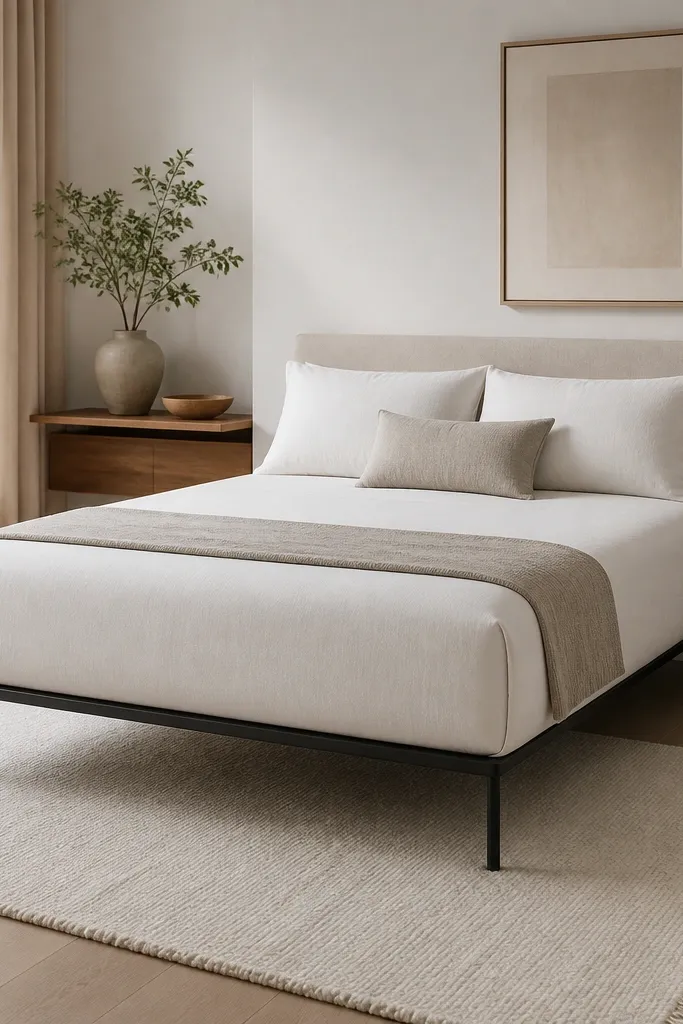
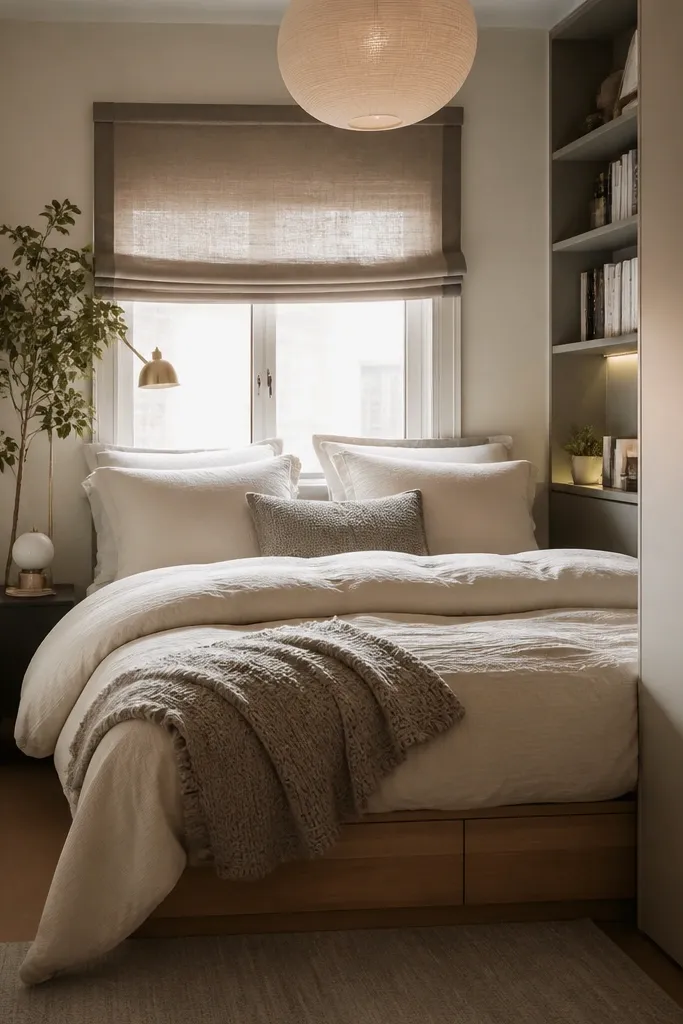
This setup works because the bed doesn’t create a heavy block from floor to ceiling. The visible legs let daylight and sightlines pass underneath, so the room feels less “boxed.” I’ve used this exact approach in rooms with low ceilings and it still reads taller because the eye keeps moving. Stick to warm whites, oat, or soft greige for the duvet and pillowcases so your space stays bright without looking like a hospital.
Start by choosing a bed frame with legs at least 6 inches high. Then tuck the duvet in at the sides so there’s a clean, tailored edge — aim for the duvet to hang just 1-2 inches over the mattress seam. Add a thin runner or folded blanket that stops around the width of your nightstand, not past the bed’s sides. Finish with a rug that goes under the front legs but doesn’t need to extend far beyond — in small rooms, partial rug coverage looks bigger than full coverage.
If you want maximum light, use a duvet cover with a matte texture instead of shiny satin.
Avoid thick bed skirts that puddle on the floor — they instantly make the room look smaller.
2. Mirrored dresser face-down trick
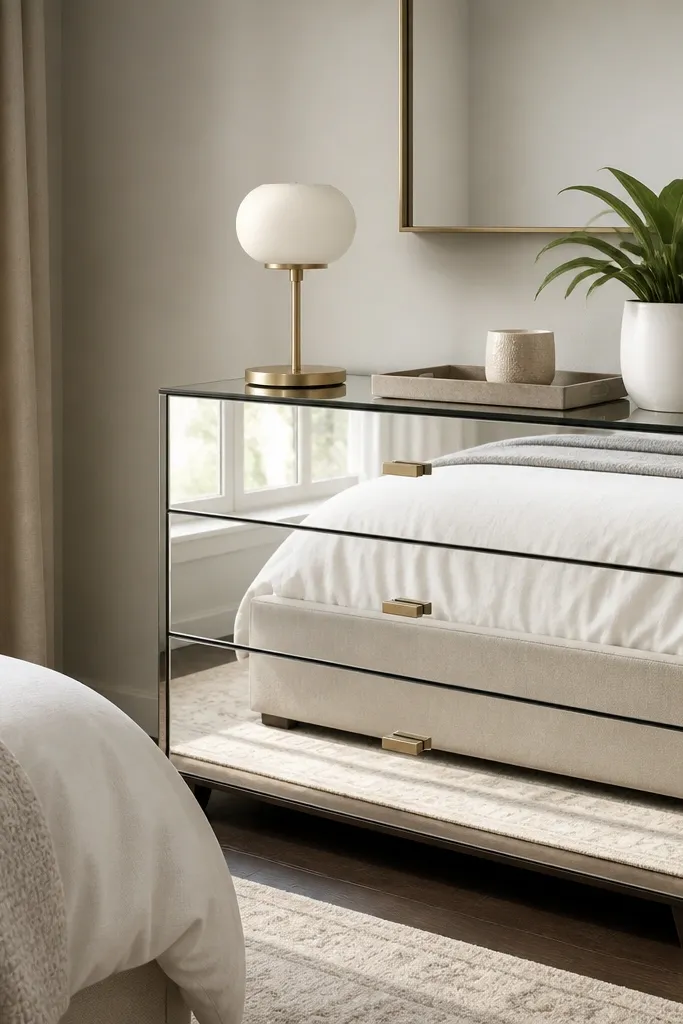
Mirrors make small bedrooms feel bigger when they reflect something bright and calm. In my own setup, I placed a mirrored dresser across from the window, and the room instantly looked less cramped because the reflected light spreads across the walls. This is especially good for beginners because it gives you a noticeable effect without redesigning the whole layout. Go for a dresser with a mirrored front or mirrored panels, not a full wall mirror that can look too “hard” if the rest of the room is dark.
Start by measuring the wall opposite your window or your main light source. Place the mirrored dresser so it reflects the window or a bright wall, not a cluttered corner. Style the top with one tray (about 12x18 inches) and keep items clustered in the center, leaving at least 4-6 inches of bare surface around it. Use a warm lamp shade — cream or light sand — so the reflection looks soft, not bluish.
Good to knowWipe the mirror with a microfiber cloth and a drop of glass cleaner so you don’t get streaks that read “dirty” in small spaces.
AvoidAvoid placing mirrors where they reflect your bed clutter or laundry basket.
3. Curtains that start above the ceiling line
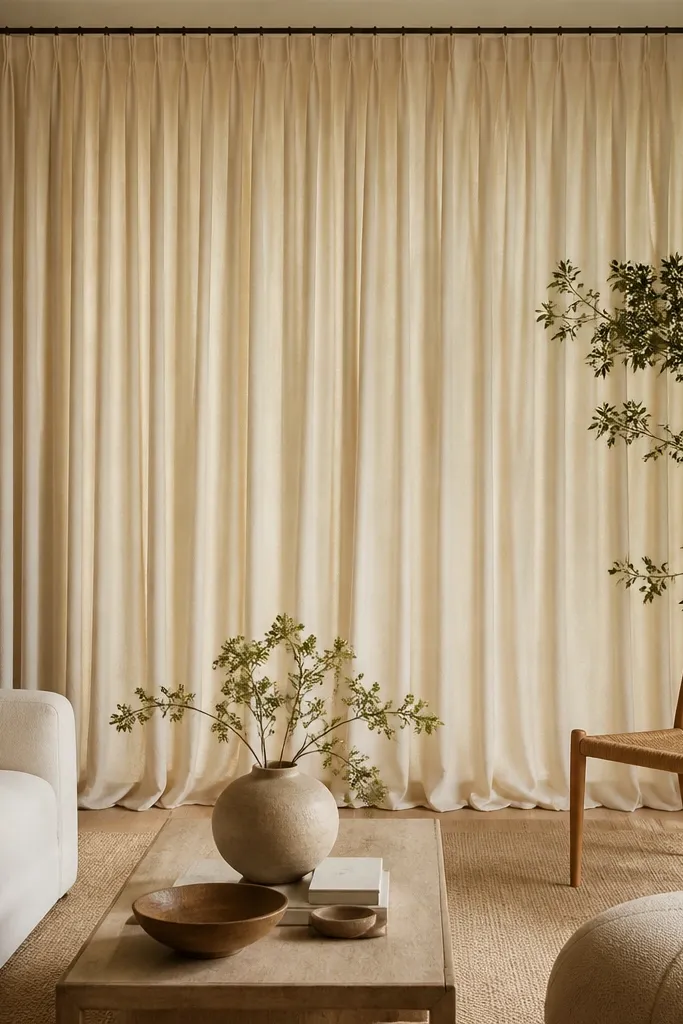
When curtains hang high and wide, your brain reads the walls as taller and the window as larger. I’ve done this in narrow bedrooms where the window looked “small” and the room always felt tighter than the measurements. By raising the rod about 4-8 inches above the window trim and using longer panels, you create vertical lines that pull the eye upward. Use a medium-weight fabric like cotton-linen blend or smooth polyester with a soft drape so it doesn’t cling and look cheap.
Start by installing the curtain rod 4-8 inches above the window trim, or closer to the ceiling if you can. Choose panels that reach the floor with a small break — about 1-2 inches of puddle is plenty. Then widen the curtain coverage so the closed curtains overlap by 4-6 inches at the center. Use two panels per side if your window is narrow, because stacked folds look richer and make the window feel bigger.
If you can, mount the rod brackets into studs — small rooms show rod sagging immediately.
Avoid hanging curtains at the window top — it shortens the room visually.
4. Corner desk + floating shelf nightstand combo
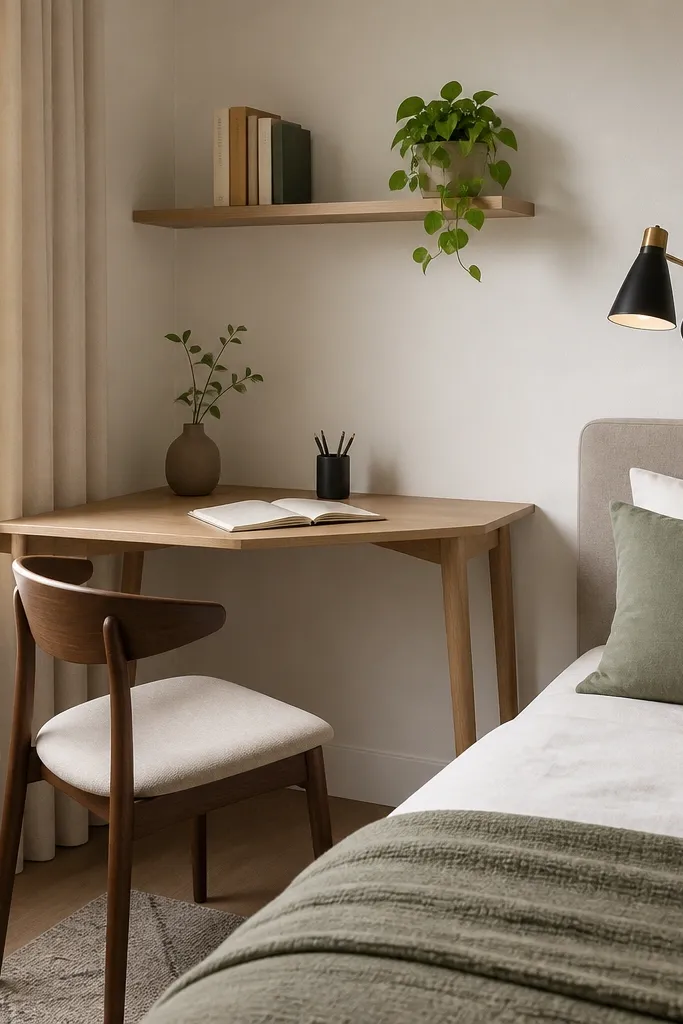
In very small bedrooms, you need one station for real life — charging, water, book — without taking up floor space. A corner desk gives you a work or makeup spot that doesn’t fight the bed footprint, and a floating shelf acts as a nightstand without the bulk. I like this for beginners because it’s measurable: you can keep the desk width around 20-28 inches and still get function. The look stays airy when the desk is slim and the shelf is minimal, with light wood or matte white finishes.
Start by placing the desk in the room’s “dead corner,” usually the part that gets the least foot traffic. Keep the desk depth around 16-20 inches so your chair doesn’t steal the walkway. Mount a floating shelf 28-32 inches high so it matches a comfortable night reading position. Style the shelf with one tray for small items, then add a wall sconce or plug-in lamp so you’re not adding another table.
Use a power strip with a flat plug behind the desk so cords disappear behind the shelf line.
Avoid a desk that’s too deep — 24+ inches turns your bedroom into a hallway.
5. Wardrobe wall with sliding doors
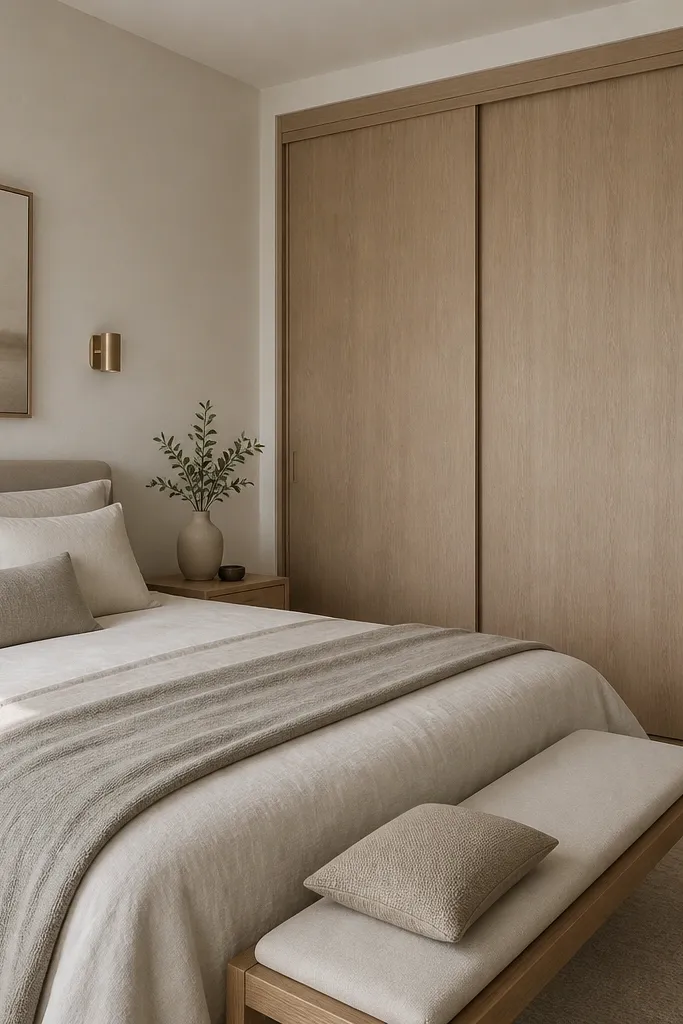
If your closet door swings into your space, it creates a constant obstacle even when you’re careful. Sliding doors remove that swing clearance problem, and the room feels instantly more usable. I’ve replaced hinged doors in a tiny room and the difference in daily movement was huge — you stop planning your steps around hardware. Keep the doors light and smooth, like light oak or matte white, so they don’t look bulky against the wall.
Start by measuring the closet opening and check that your door track can mount without hitting window trim. Choose doors with a track that clears the floor by a small amount and feels sturdy, not wobbly. Place the bed so there’s at least 30 inches between the bed side and the wardrobe wall for sitting up. Use interior organization bins and hang only what you need at shoulder height so the wardrobe stays visually neat.
Good to knowPaint the inside of the wardrobe a soft white so dark clothes don’t visually “spill” into the bedroom.
AvoidAvoid leaving the closet door open for easy access — it makes the room look messy all day.
6. Single tall bookcase for vertical storage
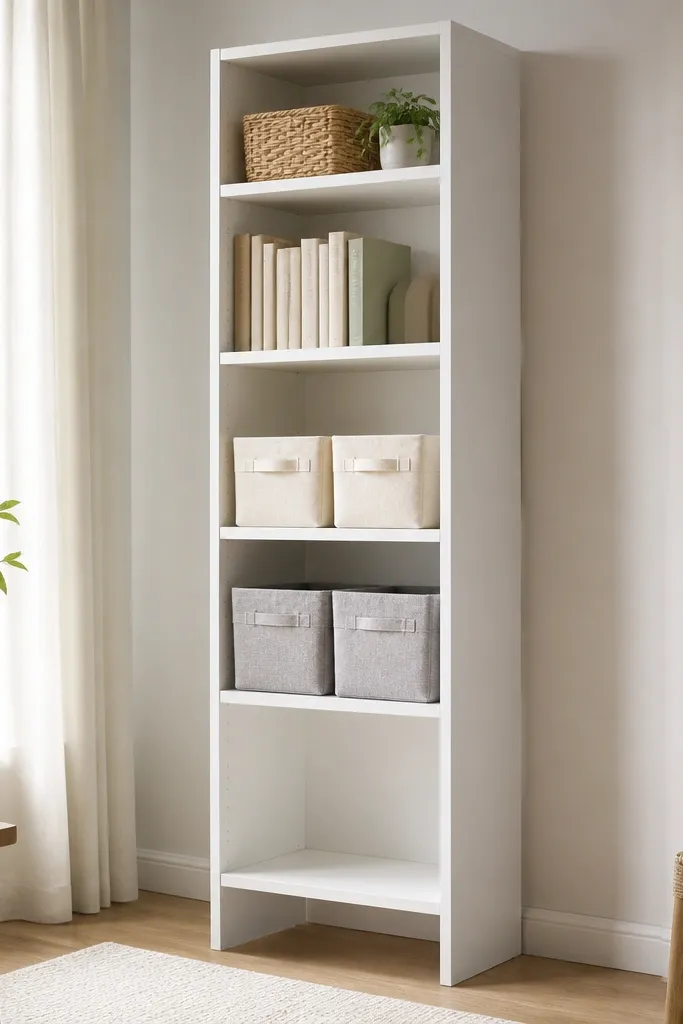
Vertical storage makes a small bedroom feel calmer because it keeps clutter off surfaces at waist height. A tall bookcase also gives you a place for items that would otherwise sit on the floor — bags, extra linens, and seasonal clothes. In my experience, the best-looking setups keep the bottom shelf light and visible, even if you store more higher up. Choose a slim width around 12-16 inches so it doesn’t squeeze the room.
Start by picking a bookcase height that reaches close to the ceiling, leaving 2-4 inches for dusting. Place it along the longest wall, not in the main walkway. Use baskets for anything that looks messy, then keep books oriented upright so the shelf looks intentional. Fold linens into matching bins and leave one shelf for “display” items like a small frame and a candle so the room doesn’t look like storage.
Use shelf liners in a light neutral so the inside doesn’t look dark and heavy.
Avoid stuffing every shelf — a little empty space reads cleaner than perfect organization.
7. Floating nightstand with wall-mounted lamp
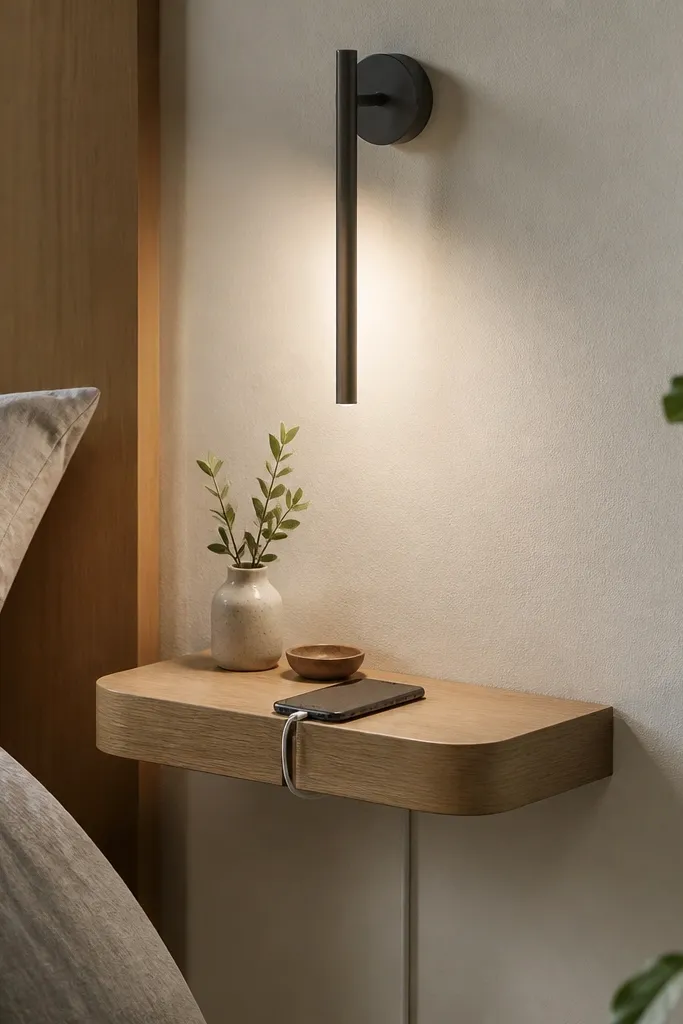
A floating nightstand is one of those changes that feels small but looks huge. It keeps the floor clear and gives you a clean line along the wall, which is exactly what tiny rooms need. I like this when you don’t have room for a nightstand at all or when the bed side feels too tight for doors and drawers. The wall lamp also keeps the bedside styling cohesive since the light source matches the shelf’s size.
Start by installing the shelf so the top surface lands around 24-28 inches from the floor, depending on your mattress height. Then mount a wall sconce or plug-in wall lamp so the light is centered over the bed side. Hide cords with a simple cord channel painted the same color as the wall. Style the shelf with one shallow tray and a book stack, leaving the front edge clear so it looks light.
Good to knowChoose a lamp with a warm bulb around 2700K so the wall reflection looks cozy instead of harsh.
AvoidAvoid a shelf that’s too deep — anything deeper than 10-12 inches starts to look like a mini table.
8. Bed placed with the head against the longest wall
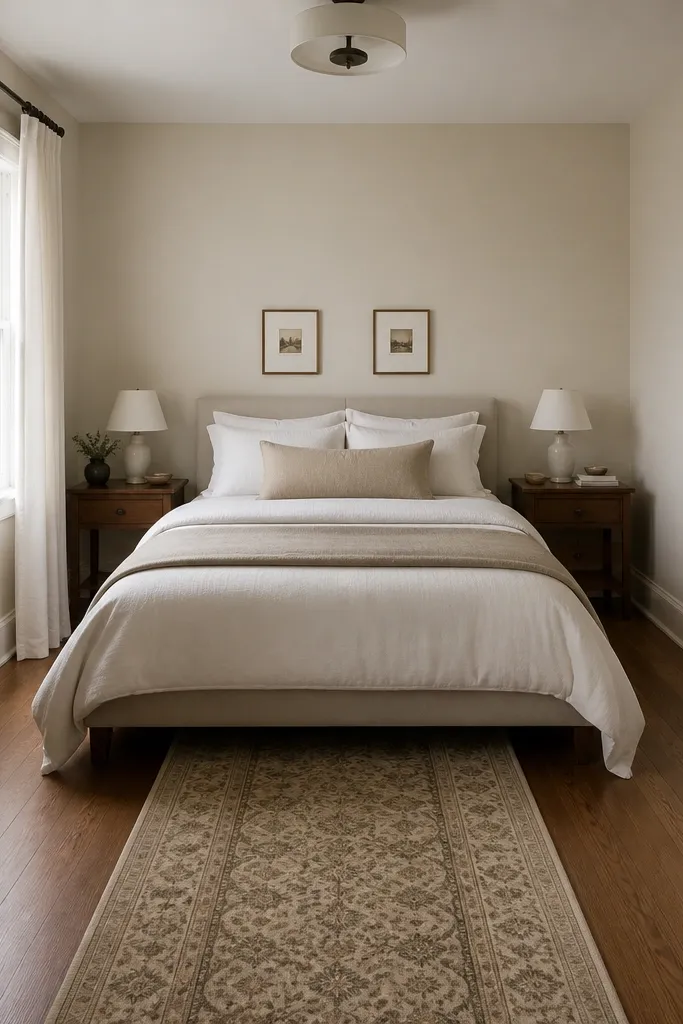
This is the layout move that fixes the “hallway bedroom” feeling. When the headboard sits on the longest wall and the bed is centered, your room reads as one shape instead of two competing zones. I’ve watched this transform bedrooms where people put the bed on the shortest wall and spent months trying to decorate around the imbalance. Centering also makes the wall above the bed look intentional, which matters in tight rooms where walls are always visible.
Start by finding the longest wall and placing the headboard there, even if it means your nightstand becomes smaller. Center the bed width on the wall so the gap on both sides looks even — aim for 6-10 inches between bed and wall if you have space. Use one narrow nightstand or a floating shelf on one side only if the other side would block a door. Add two small frames above the headboard with the bottom edge aligned to about 4-6 inches above the top of the pillows.
Good to knowIf centering is impossible, keep the bed aligned to one side wall and repeat that alignment with your curtain rod so everything looks planned.
AvoidAvoid pushing the bed too close to a side wall — you’ll feel it every time you sit up.
9. Round mirror above a slim dresser
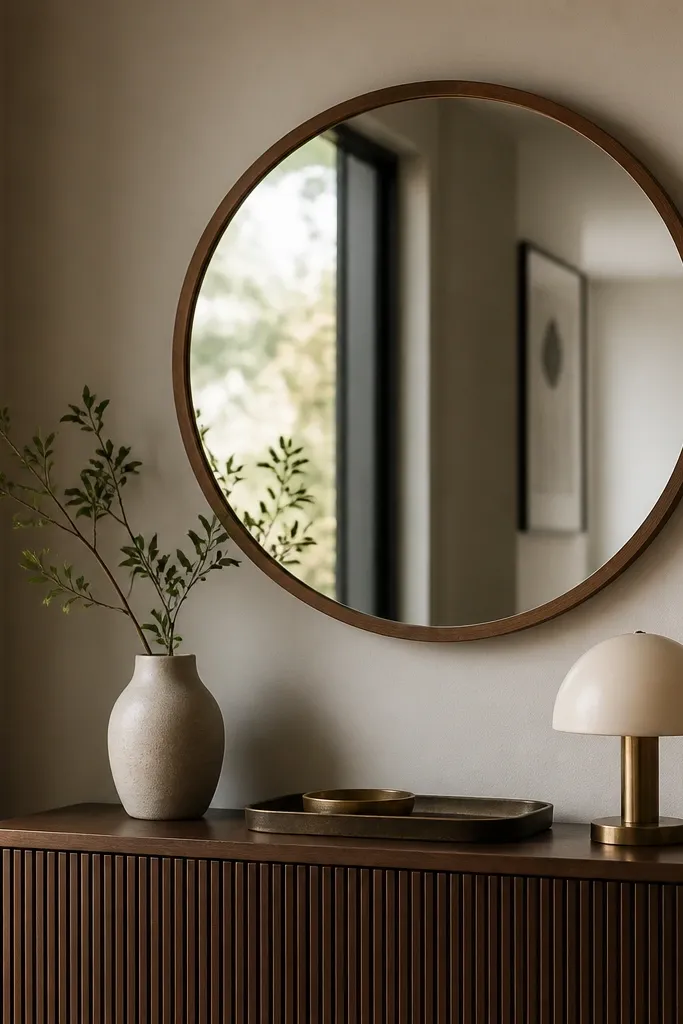
A round mirror softens the angles in a small room and still gives you the light bounce you want. The circular shape tricks the eye into thinking the space is less rigid, which matters when the furniture layout is tight. I prefer round mirrors over tall rectangles in narrow bedrooms because they don’t add more vertical “pressure.” Pair it with a slim dresser so the mirror reads like decor, not an oversized fix.
Start with a dresser width around 28-36 inches so it doesn’t crowd the wall. Hang the mirror so its center sits about 60 inches from the floor, or slightly higher if your ceiling is low. Choose a frame in matte black, brushed brass, or light oak, and keep the rest of your hardware in the same finish. Style the top with one tray and one lamp — spacing matters more than quantity in tiny rooms.
Good to knowUse a mirror with a thin frame so it doesn’t visually thicken the wall.
AvoidAvoid placing a mirror too low — it makes the dresser look like it sinks into the room.
10. Rug that stops under the bed, not beyond it
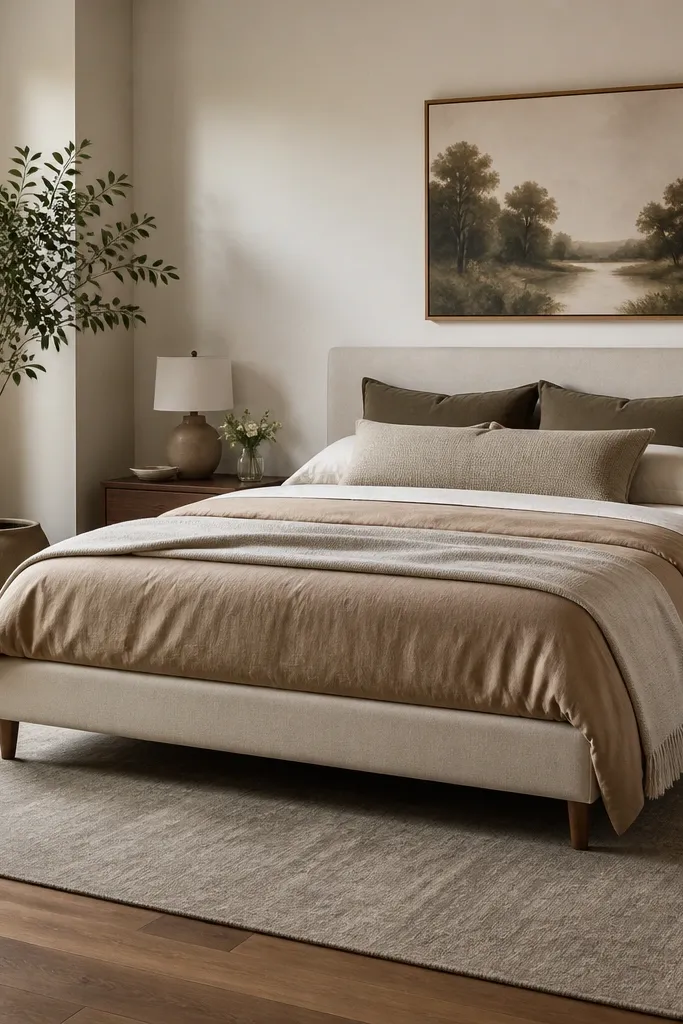
In a very small bedroom, a rug that fills every inch can make the room feel smaller because it adds another boundary line. The version that works best for me is a rug that anchors the bed while leaving some floor visible. That gives you a “floating” feel without losing coziness. Use low-pile or flatweave so it doesn’t look thick, and pick patterns that aren’t too busy — small stripes or subtle texture read bigger.
Start by pulling the rug so it sits under the front legs of the bed by about 6-10 inches. Align the rug edges with the bed frame or with the longest wall so it looks deliberate. If your bed is centered, keep the rug centered too. Choose a rug with a light base and a low-contrast pattern so it doesn’t darken the floor.
Good to knowIf you have hardwood floors, skip the high-pile shag — it traps dust and looks heavier in person.
AvoidAvoid rugs that extend past the bed on all sides — it can turn a small room into one big rectangle.
11. Two-tone wardrobe and bedding palette
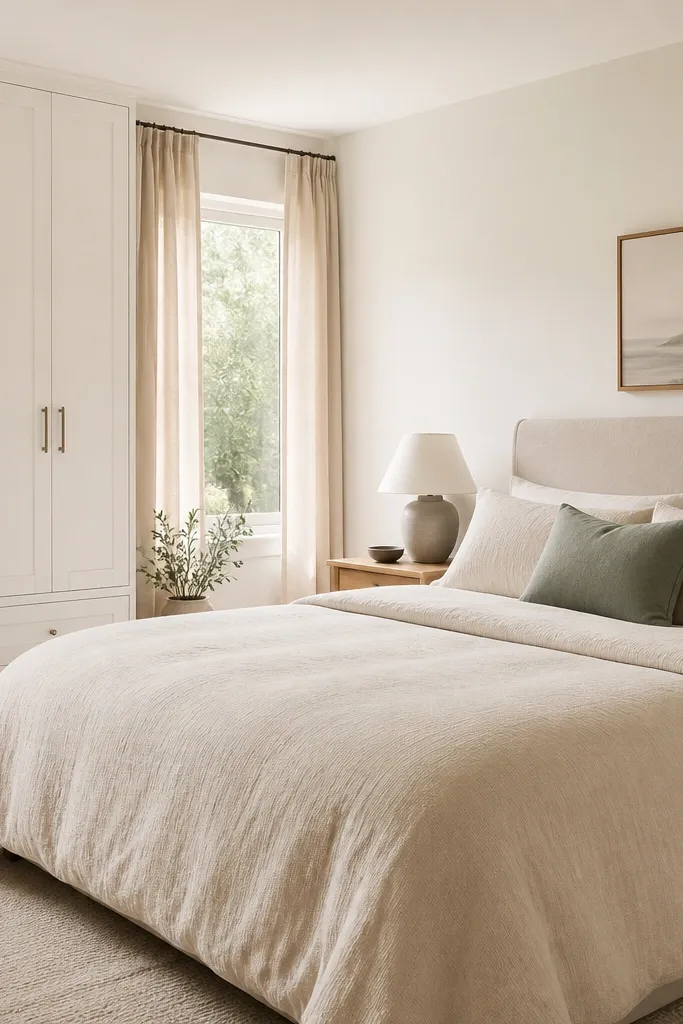
A two-tone palette makes the room feel bigger because it reduces visual noise. I like pairing a light neutral for large surfaces — walls, curtains, and the wardrobe — with one warm accent color repeated in small doses. The repeat is what makes everything look intentional, not random. This works for all skin tones and decor styles because textiles stay soft and the accent color stays calm.
Start by choosing your wall and curtain color as the “first tone,” like warm off-white or cream. Pick your second tone for bedding, like oat, sand, or light camel, and keep your throw pillow in a muted accent like sage or dusty blue. Match the curtain fabric to the bedding base tone rather than the accent. Then limit accessories — one lamp base and one frame — to that accent color so the room doesn’t splinter.
Good to knowUse fabric swatches in daylight — warm neutrals look different under LED bulbs.
AvoidAvoid mixing multiple bright colors in the same bedding set — it makes small rooms look busy fast.
12. Slim headboard with wall paneling paint
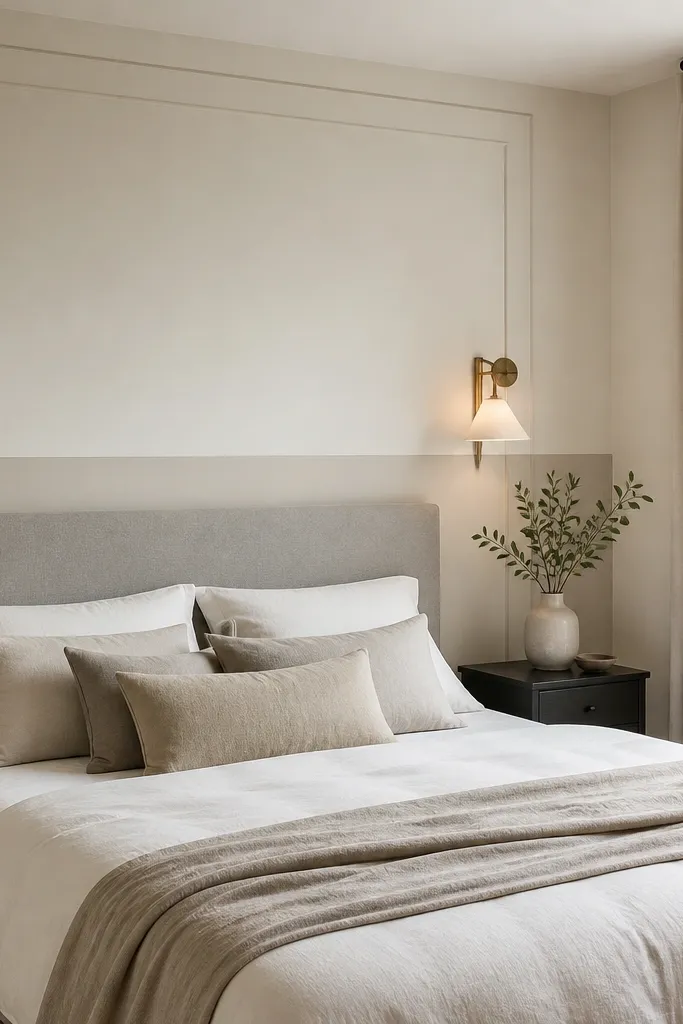
A big headboard can look great, but in a tiny room it can also eat visual space. A slim headboard keeps the bed from feeling bulky, and a painted “panel” behind it adds structure without adding furniture. I’ve used a two-tone paint treatment (same undertone, different lightness) to create depth — the wall looks more dimensional, so the room reads bigger. Keep the headboard color close to the wall so the bed feels like part of the architecture.
Start by painting the wall a warm off-white base. Then use a slightly deeper shade (like a half-step lighter than greige) for a rectangular panel area behind the bed — keep it 24-30 inches tall and centered. Add painter’s tape lines carefully and press the tape edges down to avoid bleed. Place the slim headboard centered over the panel and add one sconce so the light hits the painted depth.
Good to knowUse eggshell paint on walls so it reflects light gently and hides minor marks.
AvoidAvoid high-contrast wall patterns behind the bed — they fight the small scale.
13. Storage bench at the foot with hidden bins
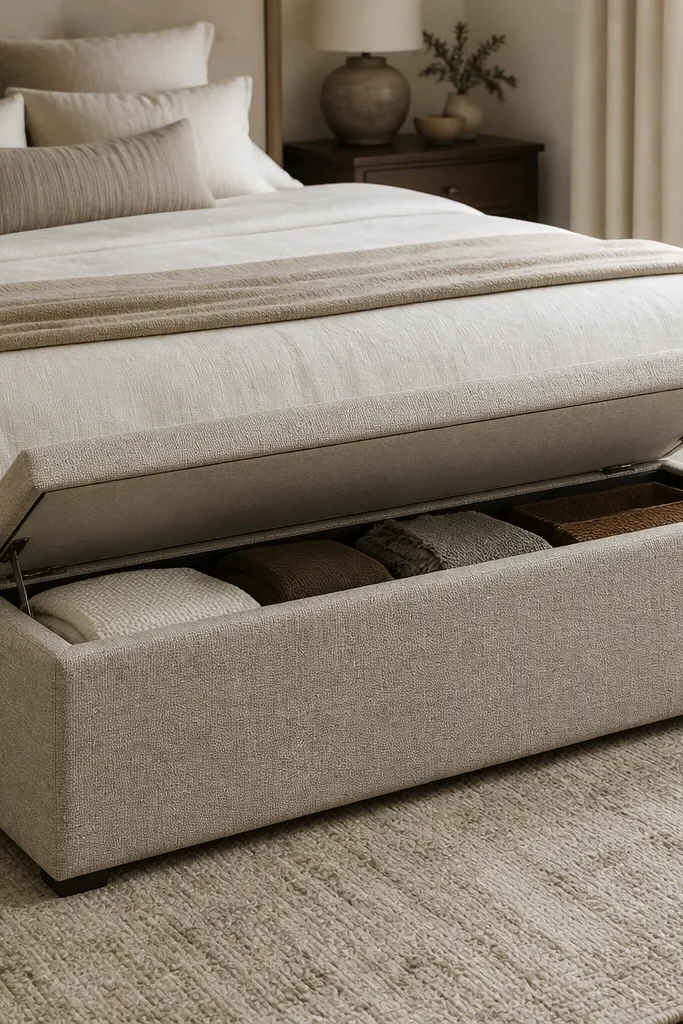
A storage bench solves the “where do I put extra stuff” problem without adding another table. In small bedrooms, the foot of the bed is the least disruptive place for storage because you’re not trying to walk around it as much as the sides. I like benches with hidden compartments because they keep things out of sight, which keeps the room visually light. Choose a bench width that matches the bed or is slightly narrower — too wide looks like a wall.
Start by measuring the space at the foot and choosing a bench that leaves at least 24 inches to the door path. Pick a bench height around 16-18 inches so it doesn’t block the bed visually. Use bins inside — I prefer fabric bins that match your bedding neutral, not bright plastic. Style the bench top with one folded throw or a couple of slim cushions, then keep the storage closed.
Add felt pads under the bench feet to keep it from scuffing and to reduce noise when you move it.
Avoid benches with open shelving — you’ll end up seeing clutter every time you walk in.
14. Tall narrow nightstand with drawer and open shelf
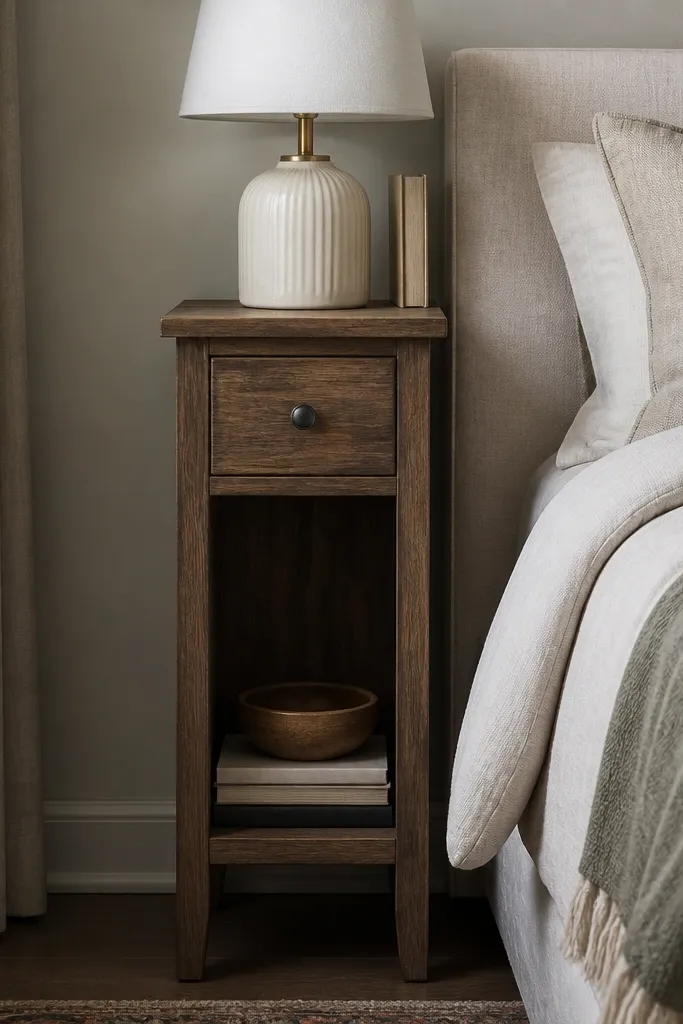
When floor space is precious, a tall narrow nightstand gives you storage without widening your footprint. It also keeps your essentials at a comfortable height while leaving the floor area around your feet more open. I’ve found this style looks best next to beds with legs because both pieces share a “light” look. Choose a finish that matches your door trim or your wardrobe — light oak, white oak, or painted white — so it blends instead of standing out.
Start by choosing a nightstand width around 12-16 inches. Place it so the front edge aligns with the bed side — don’t push it forward toward the walkway. Put everyday items in the drawer (charging cords, lip balm, glasses) and keep the open shelf for one basket or stacked books. Use a lamp with a base that fits inside the width of the nightstand so it doesn’t overhang.
Good to knowIf you have a charging habit, drill a tiny hole behind the nightstand for the cord to pass through cleanly.
AvoidAvoid a nightstand with chunky legs or bulky molding — it reads heavy in small rooms.
15. Under-bed rolling bins with a matching fabric cover
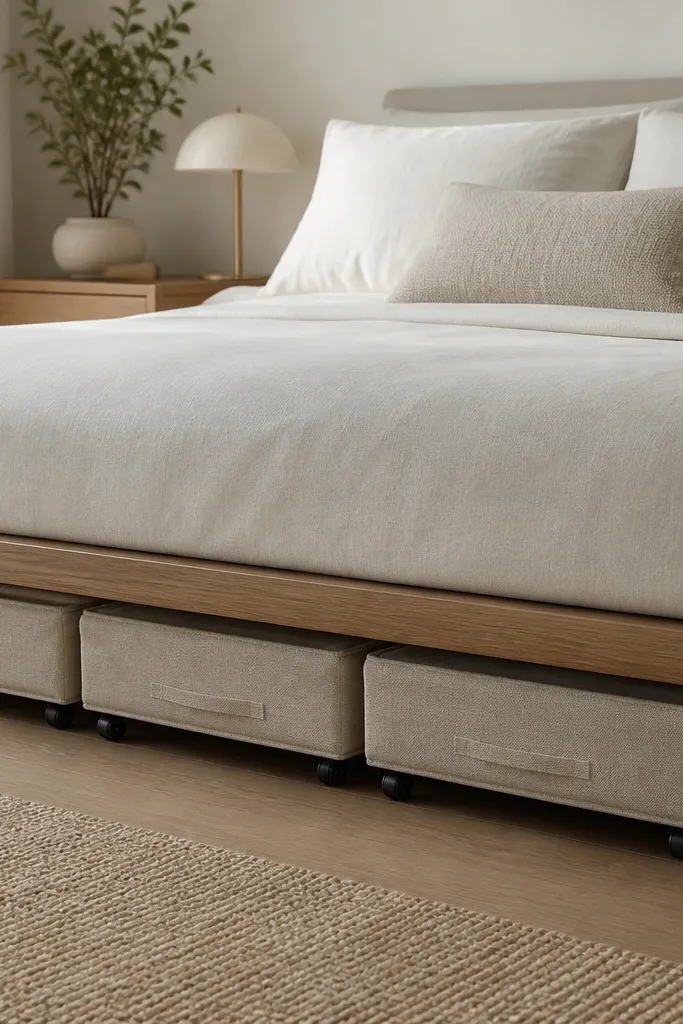
Under-bed storage is where small bedrooms win, but only when it looks tidy. Rolling bins with fabric covers keep the visual mess hidden and make it easy to swap seasonal items without pulling everything out. I use this approach when closet space is limited and the room needs to look clean even on busy weeks. Choose bins in a neutral fabric that matches your bedding so the under-bed area doesn’t create a contrasting band.
Start by measuring the clearance under your bed — you want about 2 inches of space for smooth rolling. Then choose bins with low profiles and wheels that don’t snag on rug fibers. Line up the bins so the front edges align, and keep the contents consistent — one bin for linens, one for off-season clothes, one for bulky throws. Pull the fitted fabric covers over the bins so you don’t see labels or bright colors.
Use a label maker on the inside of the bin cover so you can find things without tearing the room apart.
Avoid transparent bins in a small bedroom if you care about the look — they reveal clutter instantly.
16. Gallery wall with wide spacing and small frames
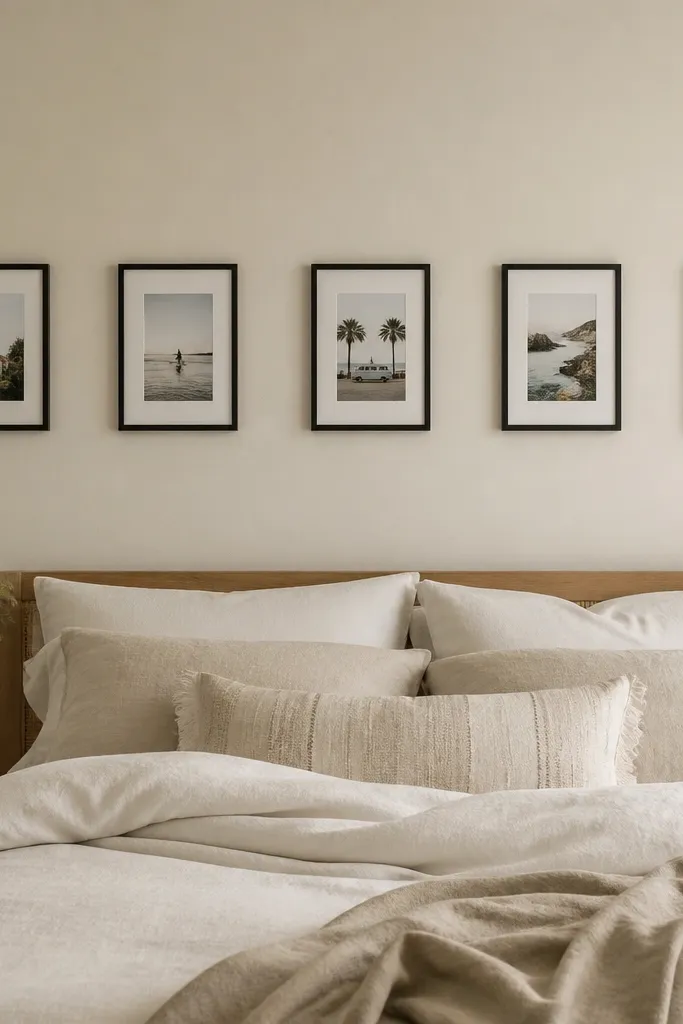
A gallery wall can make the room feel styled instead of cramped, but only if you control the scale. In a very small bedroom, small frames with consistent spacing create a “designed wall” without blocking the space. I like matte black frames because they look crisp against warm whites and don’t blend into the wall. Keep the subject matter calm — botanical prints, simple line drawings, or minimal photos — so the wall doesn’t feel busy.
Start by laying your frames on the floor and arranging them into a centered grid above the bed. Use a frame size around 8x10 inches or 11x14 inches, then keep the gap between frames about 2-3 inches. Hang the center piece so it sits around eye level when you’re lying down — roughly 50-55 inches from the floor. Use the same frame finish and mat color for every piece, then add one coordinating accent like a matching black lamp base.
Good to knowUse a level and painter’s tape to mark the corners first. Small frames show crooked lines immediately.
AvoidAvoid mixing frame sizes randomly — it makes the wall feel crowded, not curated.
17. Soft canopy over the bed with sheer curtains
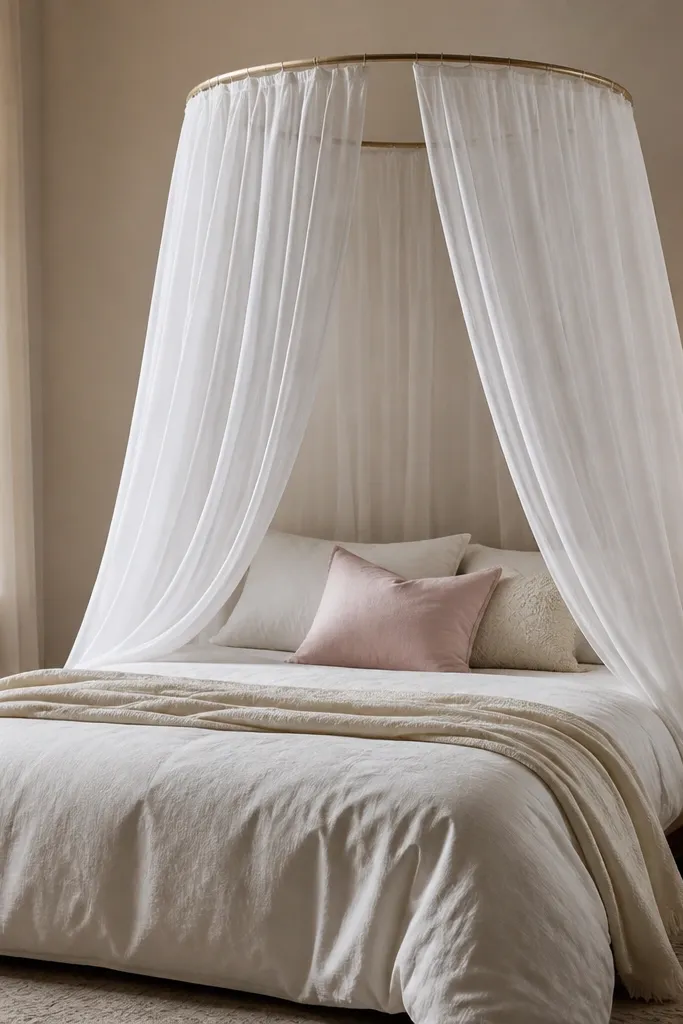
A canopy sounds fancy, but in a tiny bedroom it’s a practical way to create a “zone” around the bed. Sheer fabric adds softness and blurs clutter lines in the background, especially if your window or closet is visible. I’ve done this in guest rooms where guests store bags on chairs — the canopy visually calms everything into one restful area. Pick sheer white or warm ivory, and keep the canopy frame slim so it doesn’t add bulk.
Start by choosing a canopy kit designed for a bed or a simple hoop frame that spans the bed width. Hang sheer panels so they fall 6-10 inches past the mattress edge, not all the way to the floor. Use 2-3 panels so the fabric creates light drape rather than stiff panels. Style the bed with solid bedding and one textured throw so the sheer fabric is the only “moving” element.
Good to knowTie the canopy fabric back with ribbon when you’re making the bed so it doesn’t look messy in daylight.
AvoidAvoid thick blackout canopy fabric in a small room — it blocks light and makes the bed feel heavier.
18. Monochrome bedding with one textured accent pillow
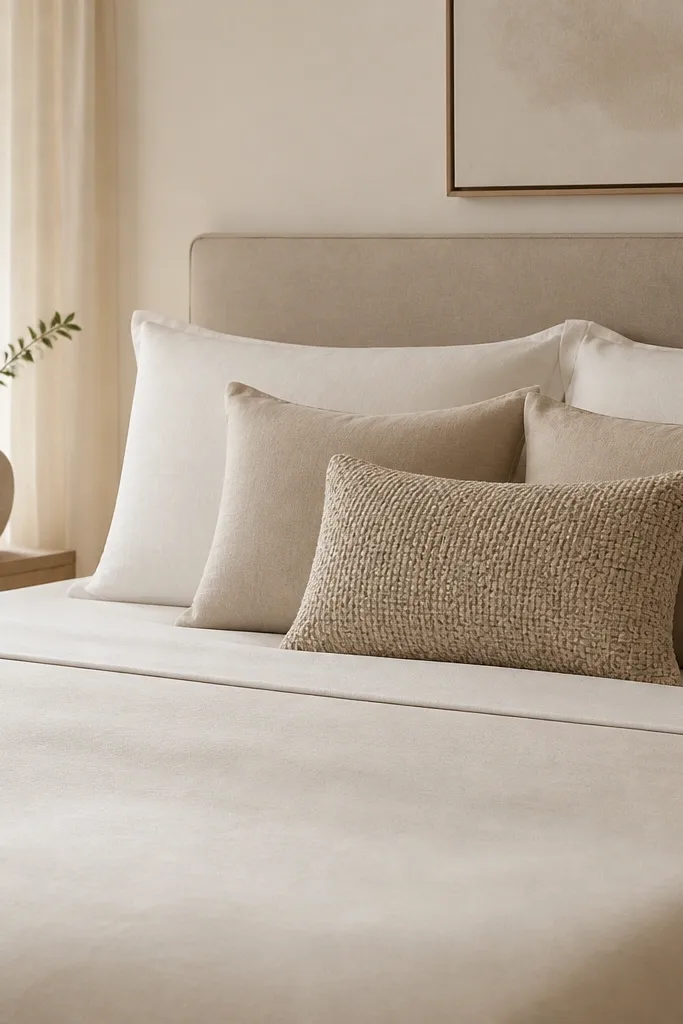
Monochrome bedding makes the bed look bigger without needing more pieces. When your duvet, pillowcases, and throw all sit in the same lightness family, the bed becomes a calm visual block and the room feels cohesive. I’ve used this approach in tiny rentals because it photographs cleanly even when the room is messy. The texture difference gives interest where color would otherwise overwhelm the space.
Start by choosing a duvet cover in one tone like oatmeal or warm sand. Then match pillowcases in the same tone family, and add one accent pillow in a different texture — knit, boucle, or woven cotton. Keep the bed throw folded neatly at the foot, about one-third of the bed length. Add one small bedside item — a lamp or a book — in a neutral finish so the room doesn’t collect visual clutter.
Good to knowPick a duvet with a crisp edge (matte cotton or cotton-blend) so the bed looks tailored, not rumpled.
AvoidAvoid mixed prints on every pillow — that makes a small bed look crowded.
19. Open shelving above the bed with closed baskets
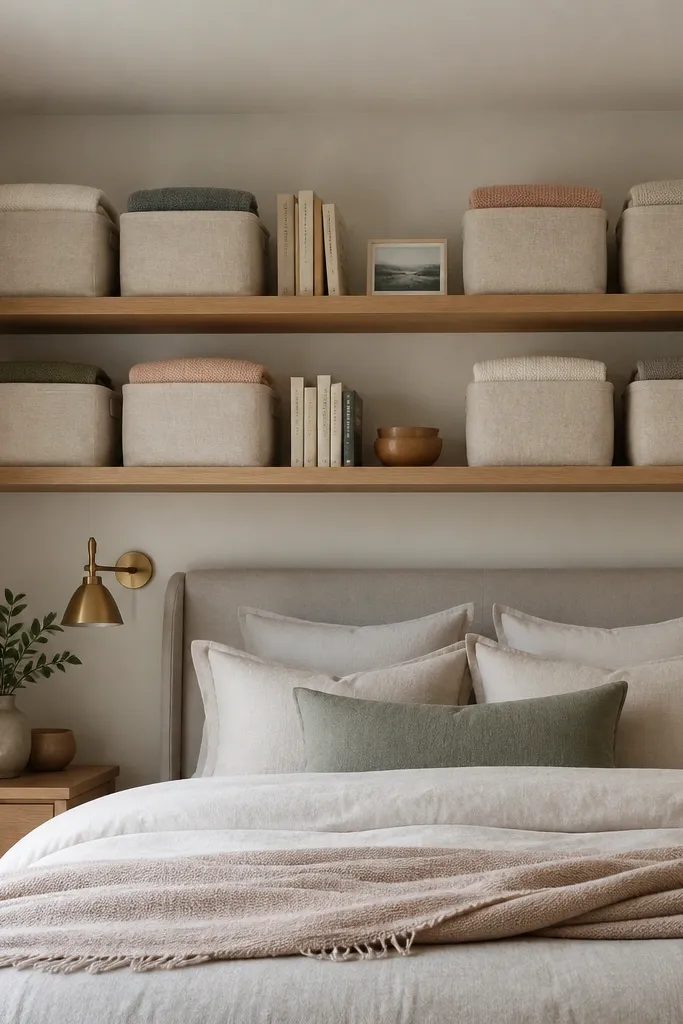
Open shelves can work in small bedrooms when you treat them like display, not storage. The shelf line above the bed adds function without eating floor space, and the closed baskets keep the look tidy. I like this when your closet is full and your floor is already packed with everyday items. Keep the number of visible objects low so it doesn’t look like you’re trying to hide clutter — it should look intentional.
Start by placing shelves directly above the bed, leaving about 8-10 inches between the top of the mattress and the bottom shelf. Use shelves that are 10-12 inches deep so they don’t protrude too far into the room. Put folded blankets and extra bedding into fabric baskets with matching neutral covers. Leave the top shelf for 2-3 upright books and one small frame, then stop there.
Good to knowUse shelf brackets with a matte finish that matches your curtain rod or lamp base so everything feels like one set.
AvoidAvoid too-deep shelves — they make the wall feel heavy and reduce the sense of openness.
20. Narrow dresser with a wall-hung TV or art panel
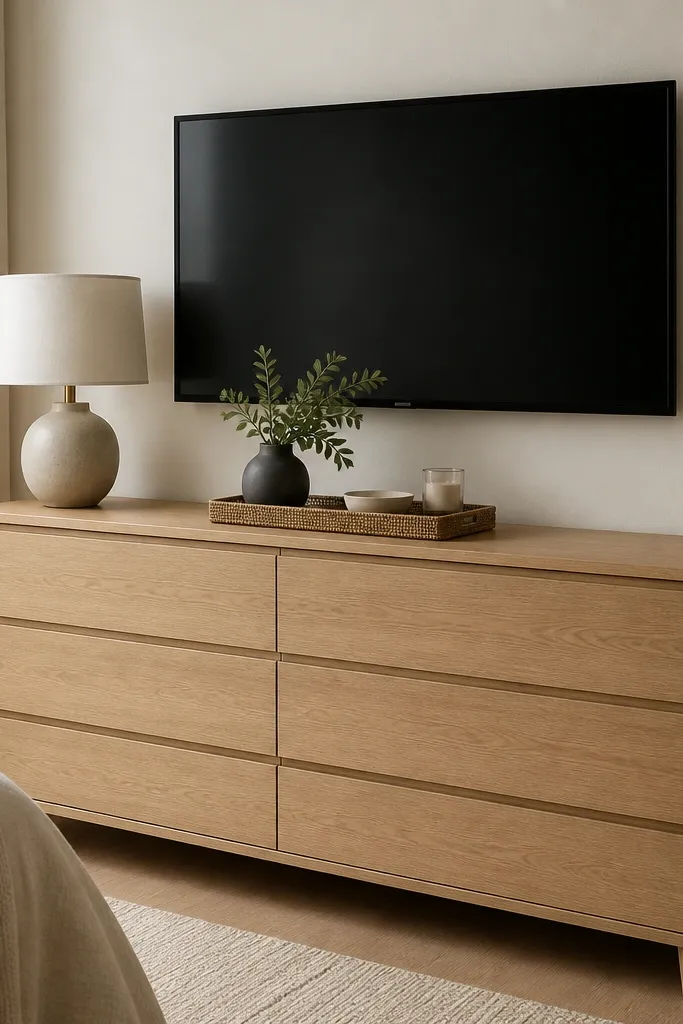
A narrow dresser plus a wall-hung screen or art keeps your visuals off the floor and stops the “clutter stack.” In tiny bedrooms, the TV or artwork is often the biggest vertical element. When you mount it, you free up surface area for only a couple items, which makes the room feel designed instead of lived-in. I’ve seen this work best with slim dressers around 30-36 inches wide and a wall mount that sits low enough to be comfortable from bed.
Start by picking a dresser that matches your bed height visually — around 30-34 inches tall — and place it against the wall opposite your bed. Mount the TV or art panel so the center is about 40-44 inches from the floor for comfortable viewing from lying down. Style the dresser with one lamp and one tray, then keep the rest empty. If you use the dresser for storage, use drawer dividers so you don’t need extra baskets on top.
Good to knowHide the cable with a cord cover painted to match the wall — it instantly looks more expensive in a small room.
AvoidAvoid a wide dresser under a wall mount — it crowds the wall and makes the room look narrower.