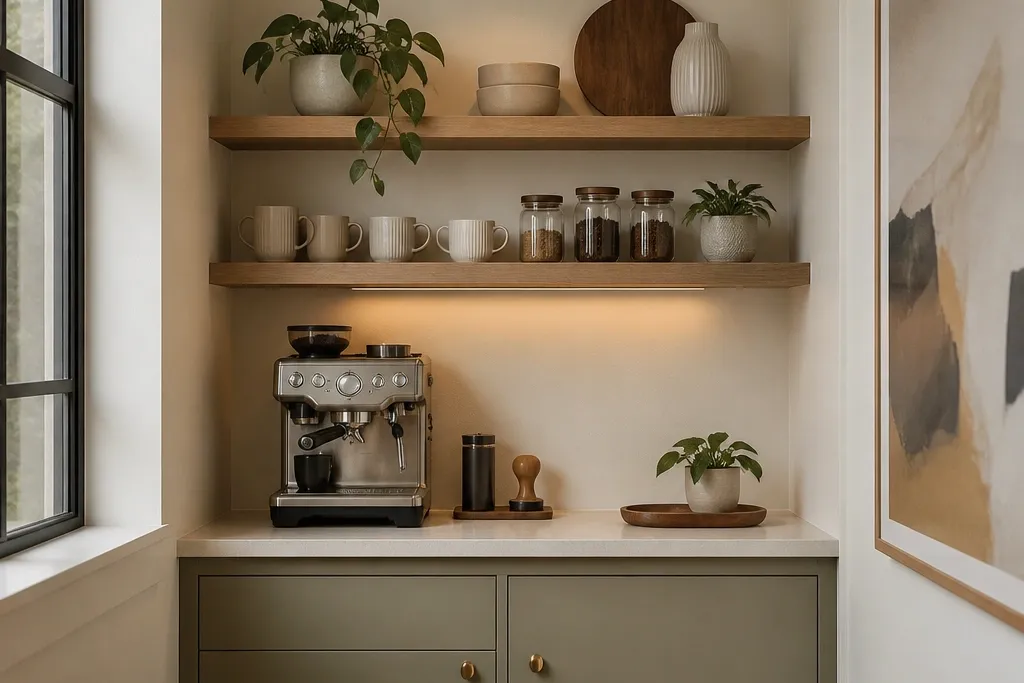
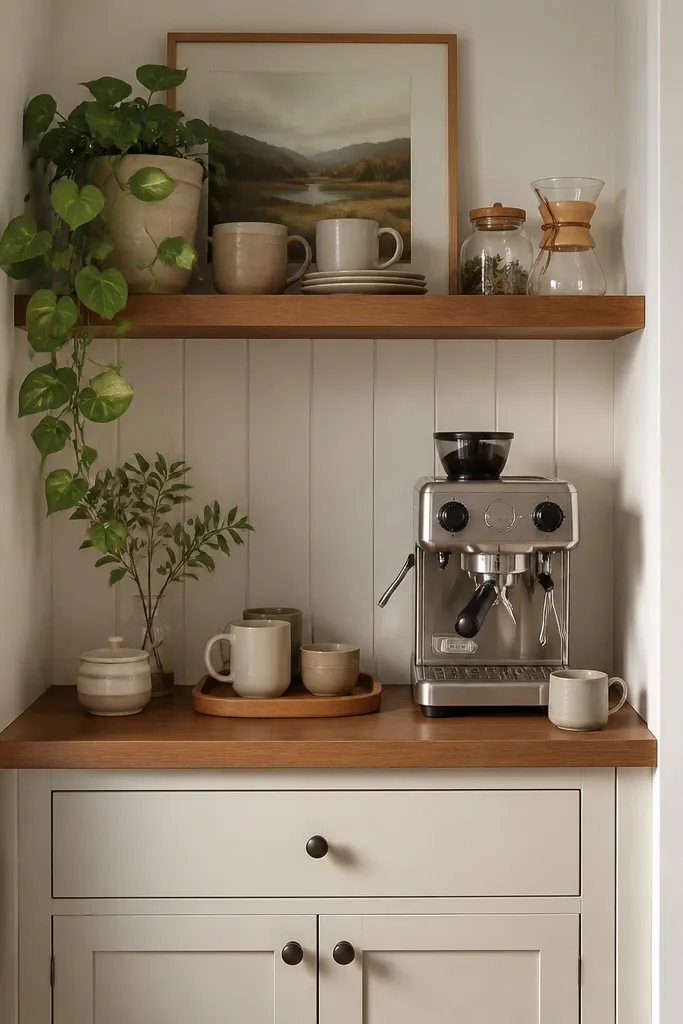
1. 24-inch floating shelf with plug-in puck lights
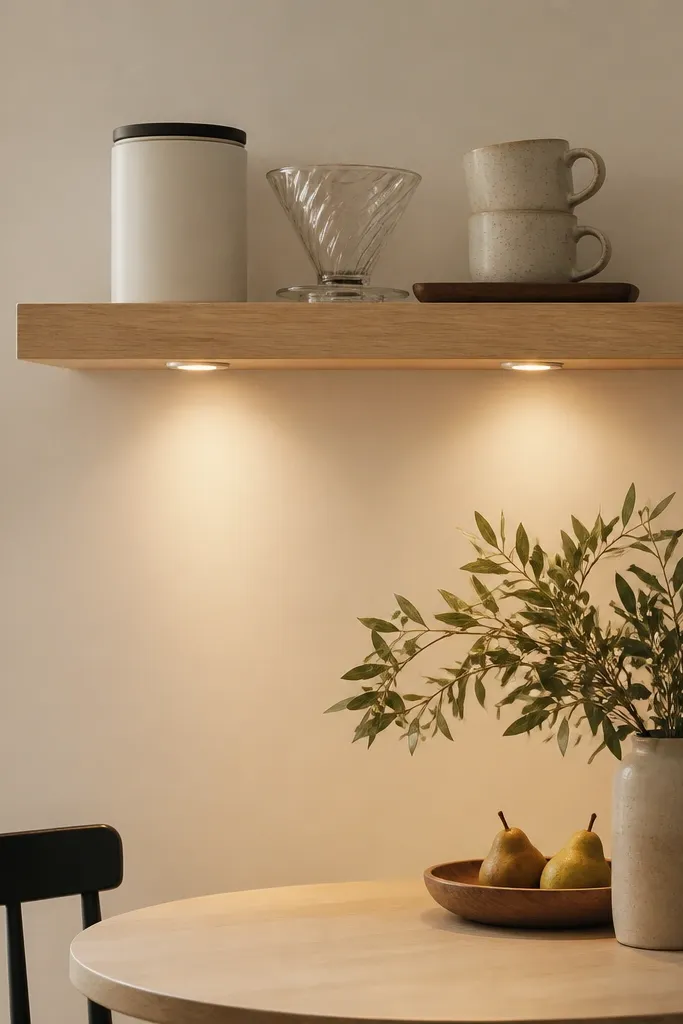
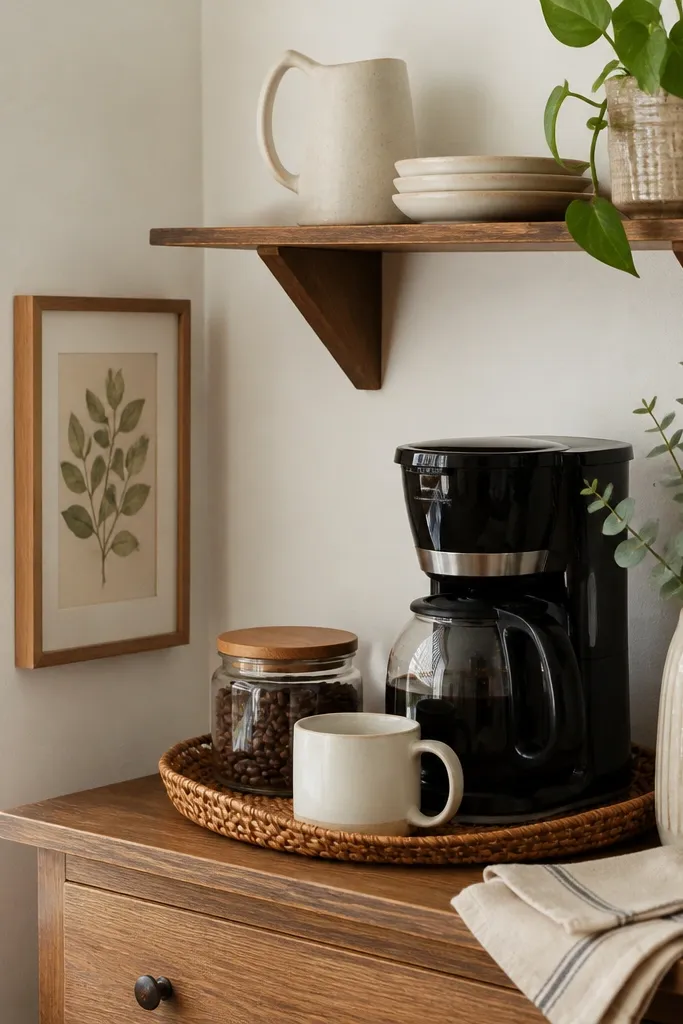
This setup works because it turns wall space into a “counter” without stealing floor area. The warm oak keeps it modern but not cold, and the white ceramic reads clean even when you’re using it daily. I like two mugs max when the shelf is small — it keeps the lineup tidy and prevents that “forgotten pantry” look. If your skin tone is fair or medium-warm, the cream mugs against oak make your hands look warmer when you pour. The styling principle is vertical clarity: light + shelf = a focal point that feels finished.
Good to knowUse a tray with raised sides so coffee scoops and spoons don’t slide off when you bump the shelf.
Start by mounting a 24-inch shelf at about 48 inches from the floor so you can reach comfortably without hunching. Add two puck lights under the front edge of the shelf with a warm 2700K bulb so shadows don’t hide your mugs. Place a slim tray (around 10 x 14 inches) in the center for your daily items, then set one canister toward the left and the pour-over dripper toward the right. Keep the mugs stacked or side-by-side, but keep the total to 2-4 pieces so the shelf doesn’t look crowded. Finally, tuck all extra filters and spare scoops in a labeled jar or small basket on the lower area of the wall.
AvoidDon’t hang the shelf too low; if it’s below 42 inches, the corner looks cramped and your mugs look like they’re crowding the wall.
2. Rolling bar cart coffee corner in black and walnut
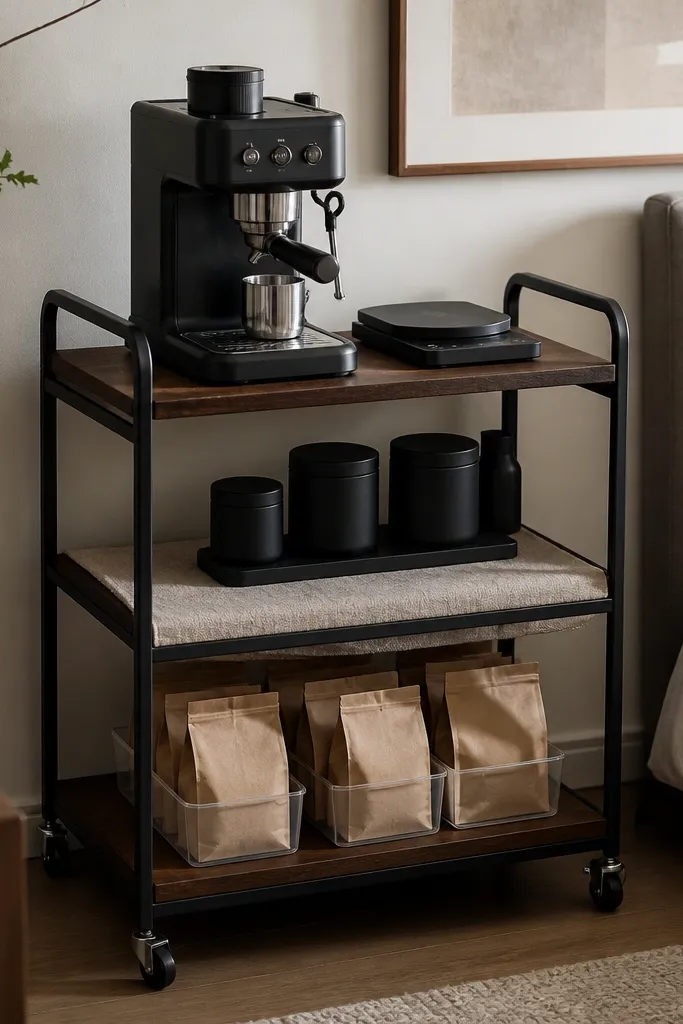
A bar cart is the best choice when you don’t have a dedicated counter and you want flexibility. The black metal frame keeps it modern, and walnut shelves soften the look so it doesn’t feel harsh in a bedroom. I’ve used this exact style in narrow rooms where the only “space” is along the wall, and it looks intentional because the cart has built-in structure. If you have deeper skin tones, walnut + black makes the ceramics and metal accessories pop without looking washed out. The principle here is mobility plus containment — the cart keeps everything in one place, even if you move it for guests.
Choose a cart that’s about 30-32 inches tall and 18-20 inches wide so it fits beside a bed or small chair. Put your espresso machine or kettle on the top shelf and keep it centered, leaving 2-3 inches of breathing room at the edges. Add a linen runner on the middle shelf and place a tray with mugs on the runner so the items look styled rather than parked. Store beans, filters, and extra supplies in clear bins on the bottom shelf with labels on masking tape. Add one small hook on the side for a towel so you don’t end up with a towel draped across the front.
Wipe the metal frame with a dry microfiber cloth each week — matte black shows smudges less than shiny finishes, but it still collects fingerprints.
Avoid mixing too many shelf colors; if you already have walnut furniture, don’t add another wood tone that clashes.
3. Corner cabinet top with a sliding tray organizer
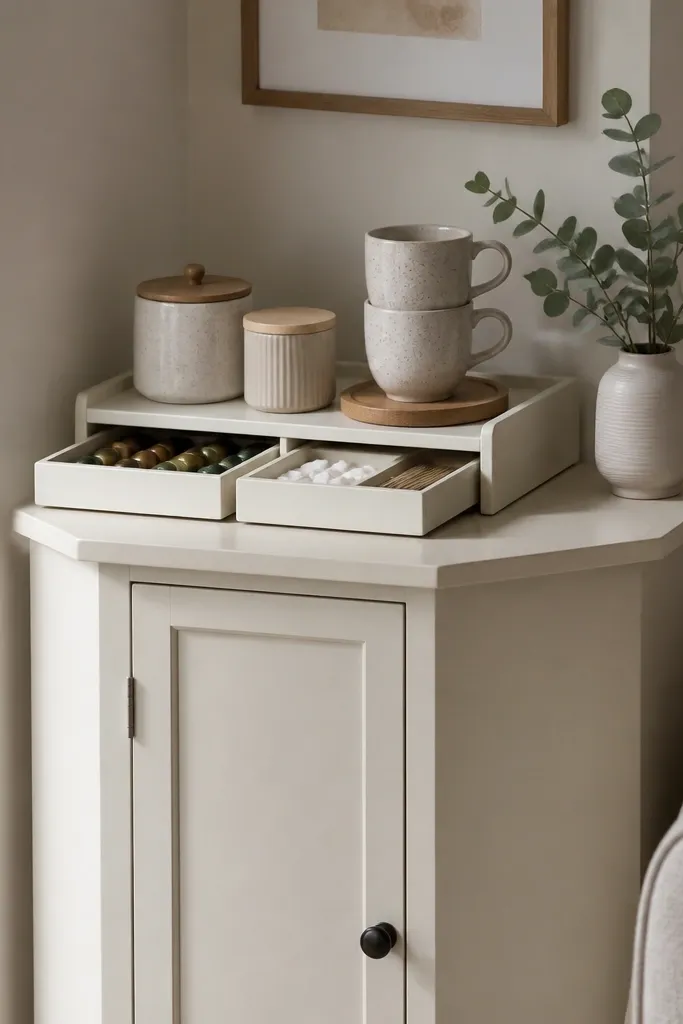
This idea is for people who hate visible clutter. The cabinet top gives you a flat surface, but the sliding tray hides the daily chaos — pods, stirrers, and spare packets. I’ve done this in a corner where the floor space is useless and the cabinet is the only solid surface, and it made the area look like furniture, not a station. Cream cabinetry makes the corner feel calm, and the eucalyptus adds a soft texture without taking much room. The principle is concealment with one tidy “public” zone on top.
Start by measuring the cabinet top — aim for a tray organizer that’s no wider than the top by about 2 inches on each side. Set the tray in the center, then place a small sugar jar and a creamer cup in the outer compartment so they don’t rattle. Put two mugs on a small round tray or coaster, positioned slightly toward the front edge for easy grab-and-go. Add a tiny vase or faux stem only if you can keep it under 8 inches tall so it doesn’t block your reach. Store everything else inside the cabinet below: filters in a drawer bin, and beans in an airtight container.
Use a tray with a lip so packets don’t fall when you slide it out.
Don’t put a tall plant or oversized decor on a corner cabinet top; it blocks the line of sight and makes the whole corner feel cramped.
4. Over-the-door rail for cups and small tools
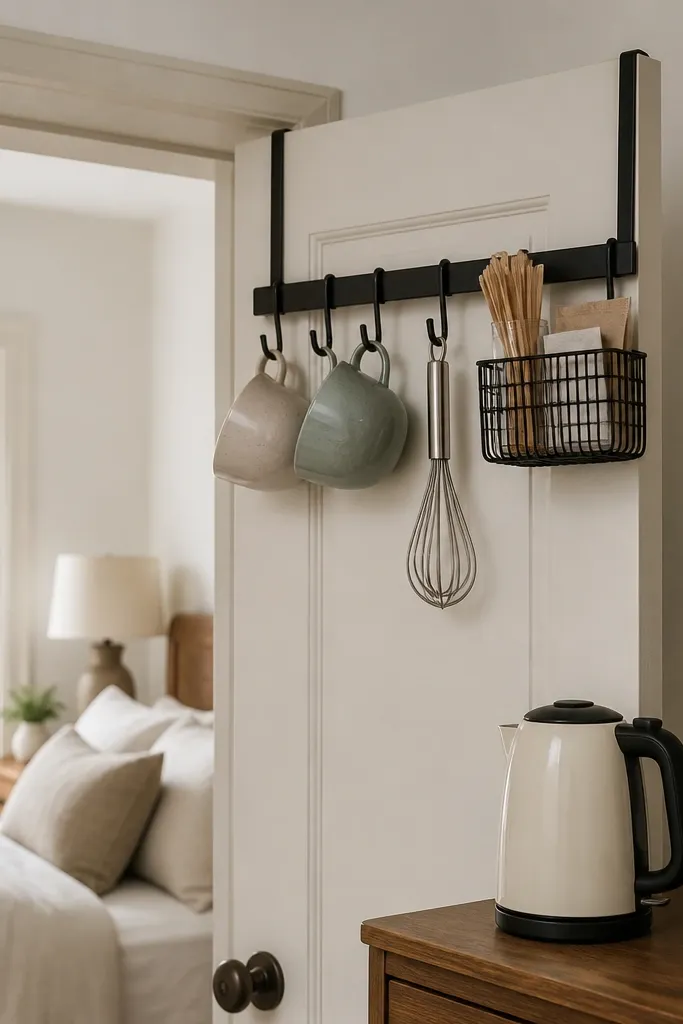
If your coffee corner is basically “whatever surface is free,” this is a lifesaver. The rail keeps cups and tiny tools off the table and stops the constant pile-up. I’ve used this in rooms where the kitchen is far and the nightstand is the only spot for a kettle, and it looks clean because everything hangs in a grid. For people with medium to deep skin tones, the contrast of white mugs against darker rail hardware looks sharp in morning light. The principle is vertical storage that doesn’t require drilling into walls.
Hang the rail so the hooks clear the highest mug handle by at least 2 inches. Use two mug hooks only — keep the rest of the hooks for small tools like a spoon, whisk, or measuring scoop. Add a small basket at the bottom for stirrers and filters so they don’t scatter. Place your kettle or maker on a nearby surface, but keep it within a 12-14 inch zone so the rail and surface look like one unit. Finish by adding a small tray under the hanging area if the door has any sliver of clearance.
Choose mugs with simple handles that won’t catch when you open the door.
Avoid overloading the hooks; 6-7 items turn the rail into a clutter net fast.
5. Built-in look with a narrow picture ledge
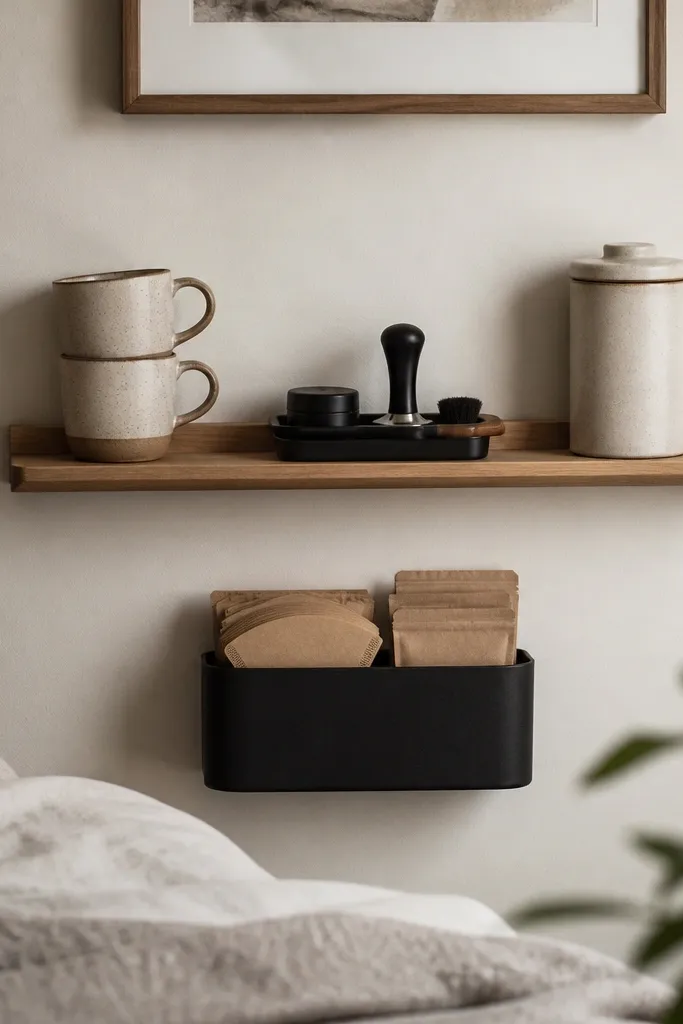
A picture ledge is thinner than a typical shelf, which makes it perfect for tiny coffee corners that need height but not depth. The matte black tray anchors the look so the lighter ceramics don’t float. I like this for people who have a lot of wall area but no room for a cart, and it makes the corner feel built-in rather than temporary. If your room is white or light gray, the ledge adds structure without darkening everything. The principle is shallow depth with strong styling — you get a “mini bar” without the mess.
Good to knowUse one color family for canister and tray (black + cream is an easy combo).
Pick a ledge depth around 4-5 inches so mugs fit without overhang. Mount it so the top of the mugs sits roughly at chest height when you stand — usually 52-54 inches from the floor. Place one tray in the middle for daily items, then add a tall canister on one side to create height. Stack two mugs on the opposite side, and keep the total items on the ledge to 4-6 pieces. Store extra supplies in a slim bin below the ledge, and make sure the bin lid closes so the corner stays clean.
AvoidDon’t use a deep ledge; deeper shelves make small corners feel like they’re spilling forward.
6. Bedside coffee corner with a tray on a narrow dresser
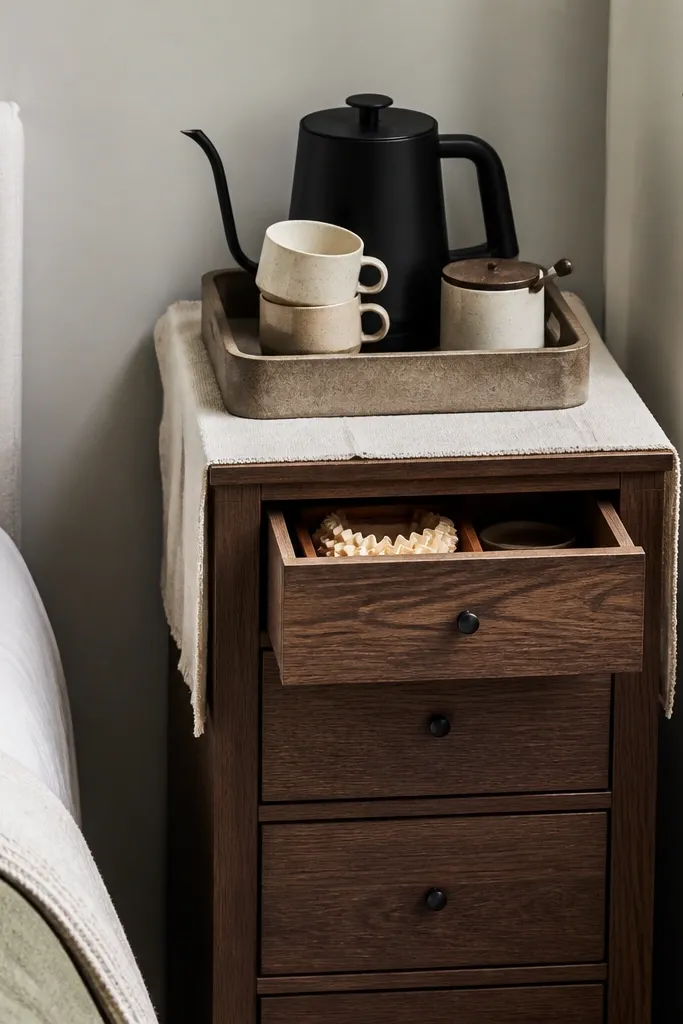
This is the “I want coffee near bedtime” setup that still looks styled. A narrow dresser gives you vertical storage without crowding the floor, and the linen runner adds warmth so it doesn’t look like a rented hotel station. I’ve used this in bedrooms where the outlet placement is tricky, and the tray makes cords easier to manage. The light linen and neutral ceramics look good on any skin tone because they don’t fight with your morning routine. The principle is containment: the tray is the boundary that tells your eye where the coffee lives.
Choose a dresser width of about 18-22 inches so it fits between bed and wall. Lay a linen runner across the top so it hangs 1-2 inches at each side, then center a tray that’s around 14 x 20 inches. Put the kettle on one end, mugs in the middle, and sugar/creamer on the other end so you’re not reaching across hot items. Store filters in a drawer organizer inside the dresser and keep the drawer closed. Add one small decor item only if it fits on the back corner of the tray without blocking your hands.
Use a tray with a matte finish so the kettle base doesn’t slide when you move things.
Avoid placing coffee tools loose on the dresser top; the second you set down a second spoon, it looks messy.
7. Wall-mounted pegboard coffee nook with labeled bins
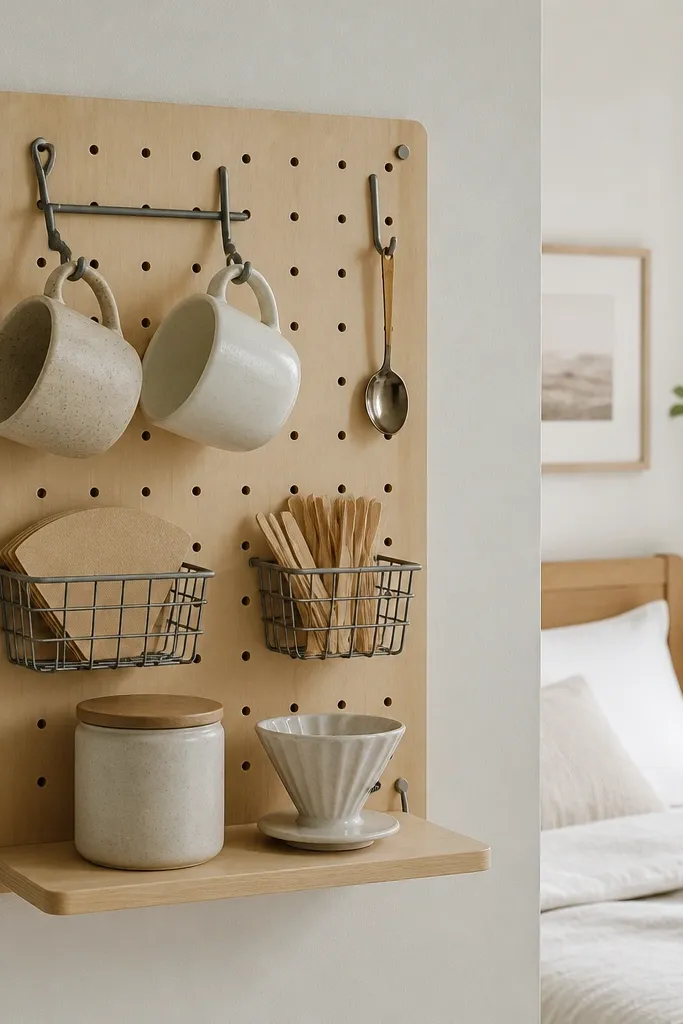
Pegboard looks modern when you keep the colors tight and the layout intentional. I like the light wood pegboard because it warms up metal hooks and keeps the corner from feeling industrial. The labeled bins are the difference between cute and chaotic — you always know where the backup filters are. This works great for small spaces because the pegboard takes wall space and keeps your counter clear. For people with darker decor palettes, light pegboard makes the coffee corner feel brighter without adding more clutter. The principle is a system: tools hang, refills live in bins, and the shelf holds the daily hero items.
Install pegboard with the holes facing outward and mount a small shelf strip on the lower third for your canister and dripper. Add hooks for two mugs and one spoon so the daily tools are always in the same spots. Hang wire bins or small fabric bins using the pegboard clips, then label them with masking tape and a fine-tip marker. Set your tray on the smallest surface you have, or skip the tray if everything is already contained on the pegboard. Keep the color palette to two metals (black and warm brass or just black) so it looks cohesive.
Measure mug handle width first and space the hooks so handles don’t bump each other when you grab one.
Avoid random placement of hooks; a messy grid reads like storage, not decor.
8. Glass-front mini cabinet with coffee pod rails
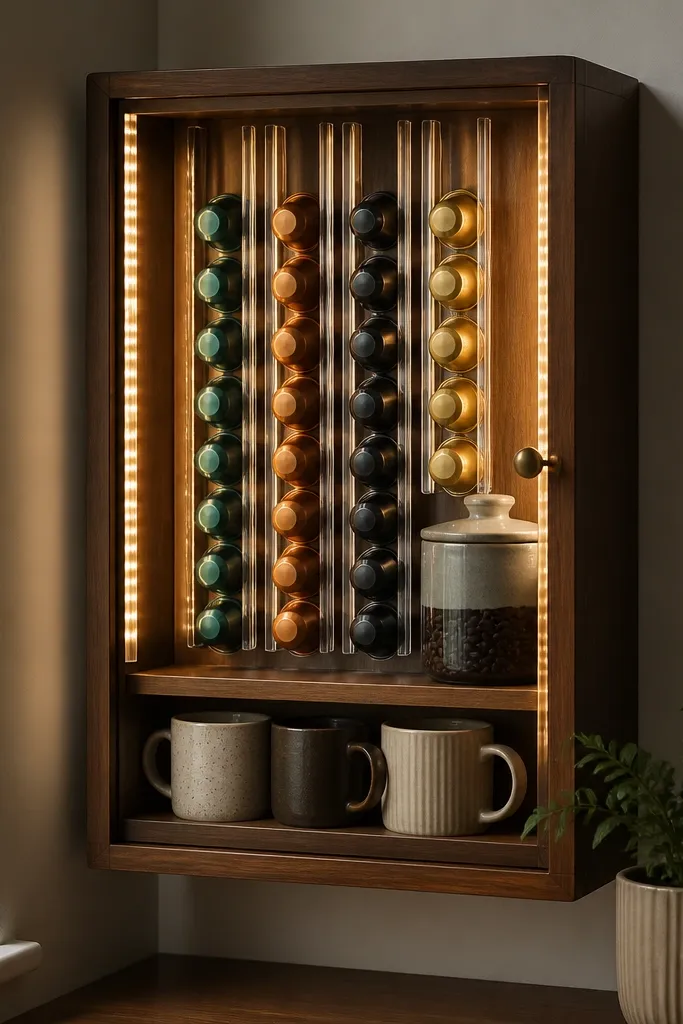
This is for the person who likes to see everything they use. The glass-front cabinet keeps the corner looking neat because pods and mugs have assigned spots behind a clear barrier. I’ve had this look in a small studio where the kitchen counter was constantly “in use,” and the cabinet made the coffee area feel like a dedicated section of the room. Warm LED light makes stainless and ceramics look better than overhead light. If you have cool gray walls, the warm glow warms the whole corner. The principle is display with structure — you’re showing the coffee, but you’re controlling the layout.
Good to knowUse pod rails with matching finish to your mug hooks so the cabinet looks intentional.
Pick a cabinet that’s narrow, around 20-24 inches wide, and not deeper than 10-12 inches so it doesn’t stick out. Add LED strip lighting along the inner sides, then install pod rails on one vertical section. Place mugs on a single shelf, keeping the count at 3-4 and spacing them so handles don’t overlap. Put coffee beans in a ceramic jar centered at the back so it reads as the focal point. Store extra supplies in a small drawer unit below the cabinet if you have room.
AvoidDon’t stuff the cabinet full; glass shows every empty spot and every messy gap.
9. Two-tier wall shelf with a vertical canister column
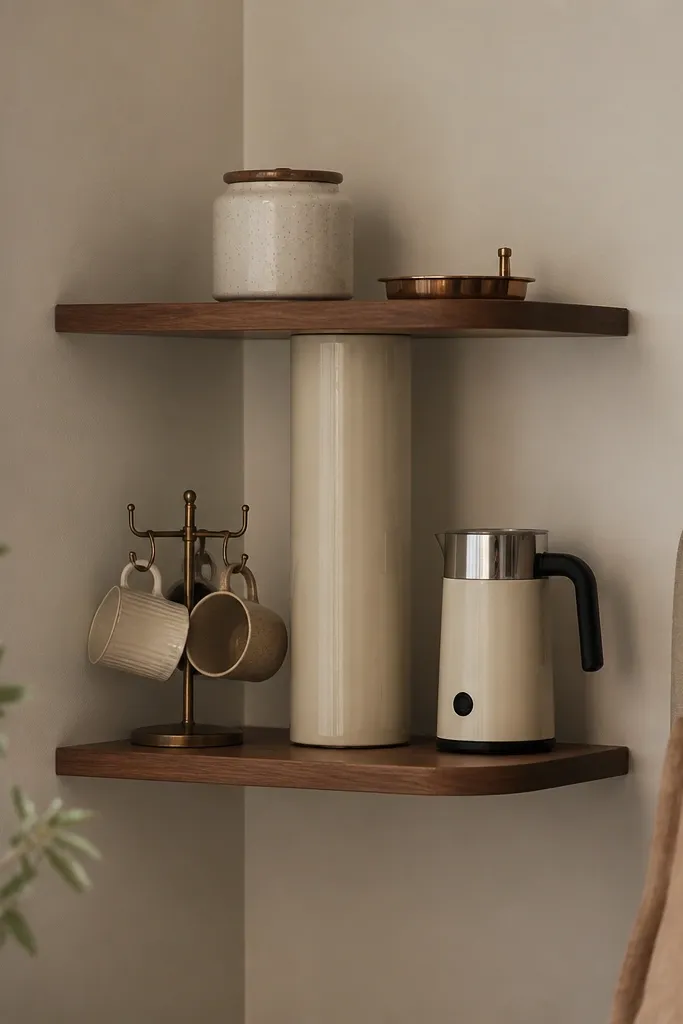
Two-tier shelves give you instant hierarchy: top for the “pretty” items and bottom for the everyday tools. The tall vertical canister column is what keeps it from looking like random stacking. I like this for small spaces because it uses height without requiring a larger footprint. The brass tray adds a soft metallic shine that looks good next to warm wood and cream walls. If you have lighter skin tones, the brass + cream combo makes the coffee corner feel bright and clean. The principle is balanced stacking — a tall center element plus two levels so your eye knows where to look.
Choose shelves that are narrow but tall enough to hold mugs on the bottom tier, usually around 16-18 inches wide. Mount the top tier about 60 inches from the floor and the bottom tier about 48 inches from the floor so mugs are reachable. Put a tall canister in the center between tiers, then set a small tray on the top shelf for dripper or spoon. Keep the bottom tier for mugs and one compact device, like a frother, so you’re not crowding. Add a small basket below or on a nearby hook for extra napkins and filter packs.
Use the same color lid on your canister and sugar jar so the corner looks coordinated.
Avoid mixing too many container shapes; it makes the two tiers look like a stack of leftovers.
10. Linen curtain behind a coffee ledge for visual softness
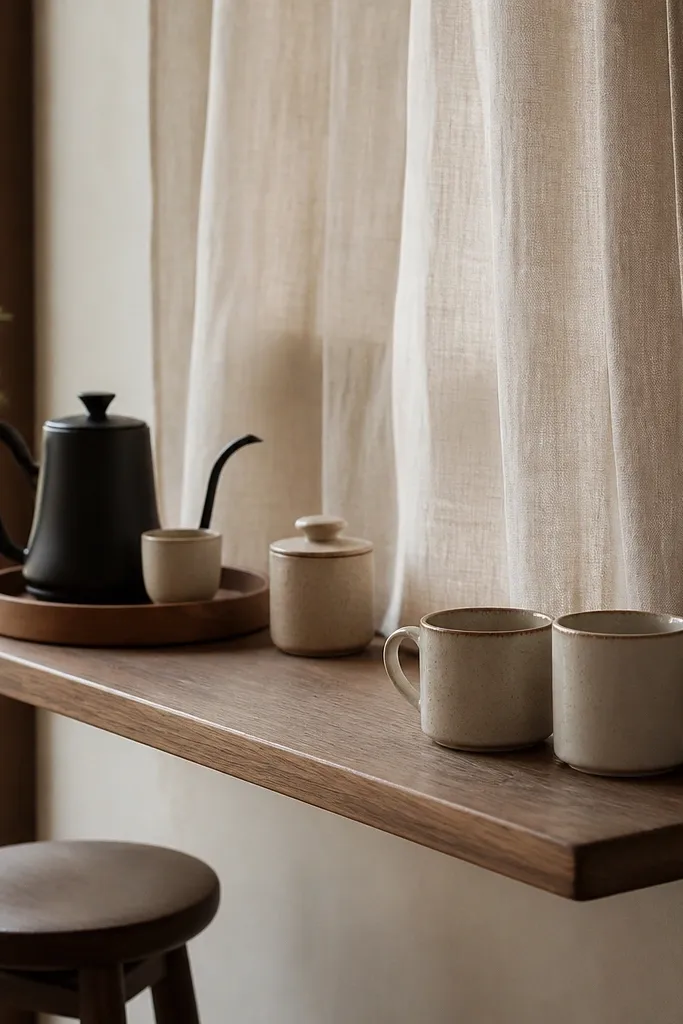
This is the one that makes a small coffee corner feel cozy instead of utilitarian. The linen curtain adds texture and hides the “background mess” like cords, a plain wall, or a shelf you don’t want to renovate. I used this in a rental where I couldn’t paint, and it made the corner look like a planned nook. Cream linen pairs with almost any color palette, and the softness makes the ceramics look warmer. For medium to deep skin tones, the linen’s warm off-white keeps everything from looking too stark. The principle is a soft backdrop so the coffee items look like they belong together.
Good to knowSteam the linen right before styling; wrinkles read messy on camera and in daylight.
Mount the ledge and then hang a linen curtain behind it, using a tension rod or two small wall hooks. Keep the curtain so it falls 6-10 inches below the ledge, not down to the floor, so it doesn’t swallow the space. Place a tray on the ledge first, then arrange your kettle, mugs, and a small canister so the curtain acts like the background. Choose mugs in a single style — either all matte or all glossy — so they don’t clash with the fabric texture. Leave open space behind the kettle so the curtain doesn’t look bunched or wrinkled.
AvoidAvoid thick blackout curtains; they make the corner feel heavy in a small room.
11. Magnetic knife strip for metal tools and spoons
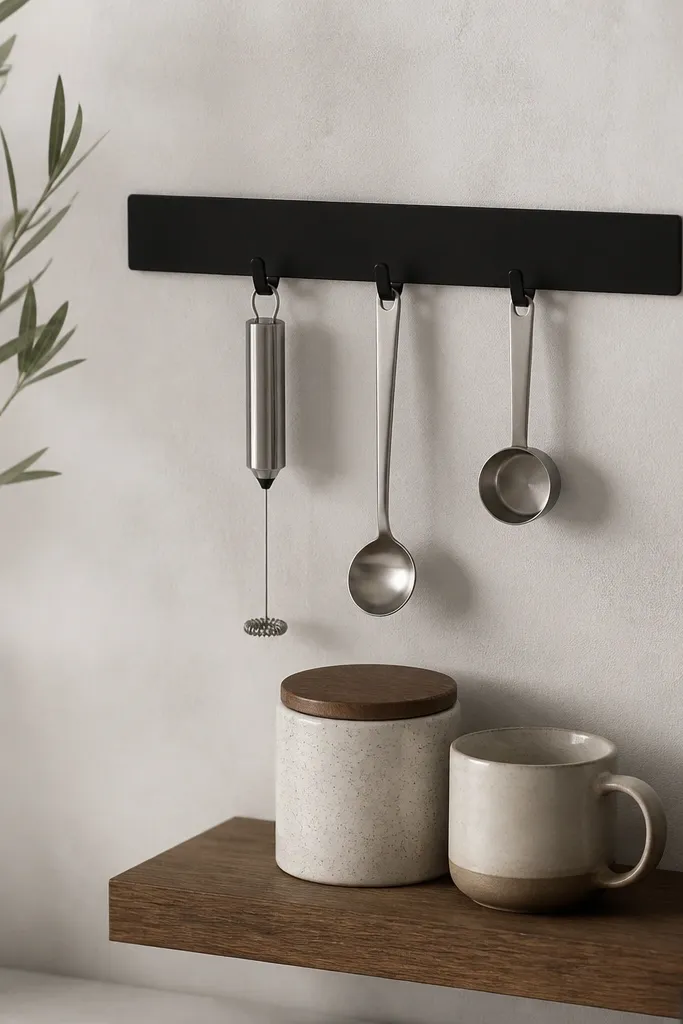
This one is for people who keep coffee tools in drawers and lose them every morning. A magnetic strip turns metal tools into a neat wall display, and it frees your counter instantly. I’ve done this near a compact coffee station and it stopped the daily mess of spoons and scoops. The black strip looks modern next to most appliances, and it hides fingerprints better than shiny stainless. If your room has black frames or dark hardware, it blends in and looks like part of the design. The principle is tool visibility with zero clutter — tools hang on the wall, not on your tray.
Mount a magnetic strip at about 52 inches from the floor so you can reach without stretching. Add hooks or small magnets for each metal tool: one for the scoop, one for a spoon, one for a whisk, and one for a small frother wand. Install a small shelf or ledge below for the canister and one mug, keeping items within a 12-14 inch width. Use a single ceramic canister and one mug style so the wall display doesn’t look random. Keep the coffee bag out of sight — store it in the cabinet or a labeled bin so the wall stays clean.
Wipe tools with a dry cloth before putting them on the strip so they don’t leave coffee residue marks.
Avoid placing non-metal items on magnets; they fall and it looks sloppy fast.
12. Under-shelf bin storage with a single open tray
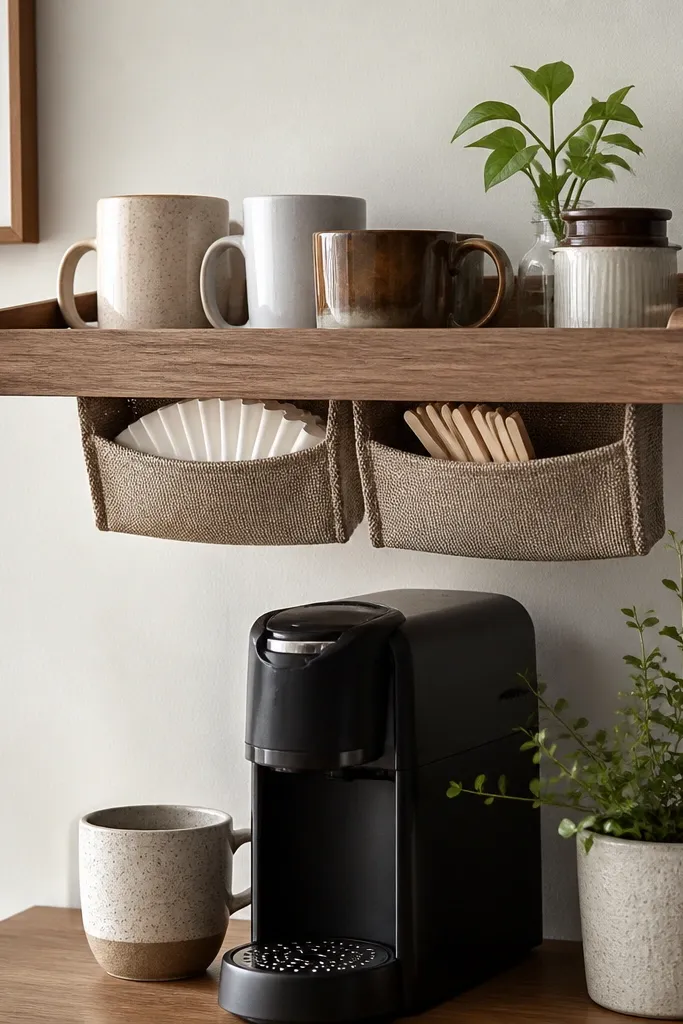
This works when you have a shelf already but you hate what’s underneath it. Hanging bins under the shelf keeps refills reachable while keeping the top surface clean and photo-ready. I like fabric bins in a neutral color because the corner looks softer than wire racks. This is also beginner-friendly if you don’t want to mount extra shelves — you use what you have. If your bedroom has a lot of soft textiles, these bins blend in without looking like add-on storage. The principle is top surface minimalism with bottom access.
Start by placing your shelf so it sits above your coffee station at least 10-12 inches higher, giving room for the bins to hang. Attach two bins under the shelf — one for filters and one for stirrers or sweeteners — so you don’t mix items. On top, use a single tray that fits the shelf width with about 1-2 inches of clearance on each side. Arrange mugs on the tray first, then place canister and dripper so you can grab everything without shifting the tray. Close your coffee bag in an airtight container and keep it out of sight so the shelf stays clean.
Use bin dividers or small boxes inside the bins so packets don’t collapse into one messy pile.
Avoid using bins that are too small; if you have to shove things in, it looks cluttered.
13. Small breakfast bar look with a fold-down wall shelf
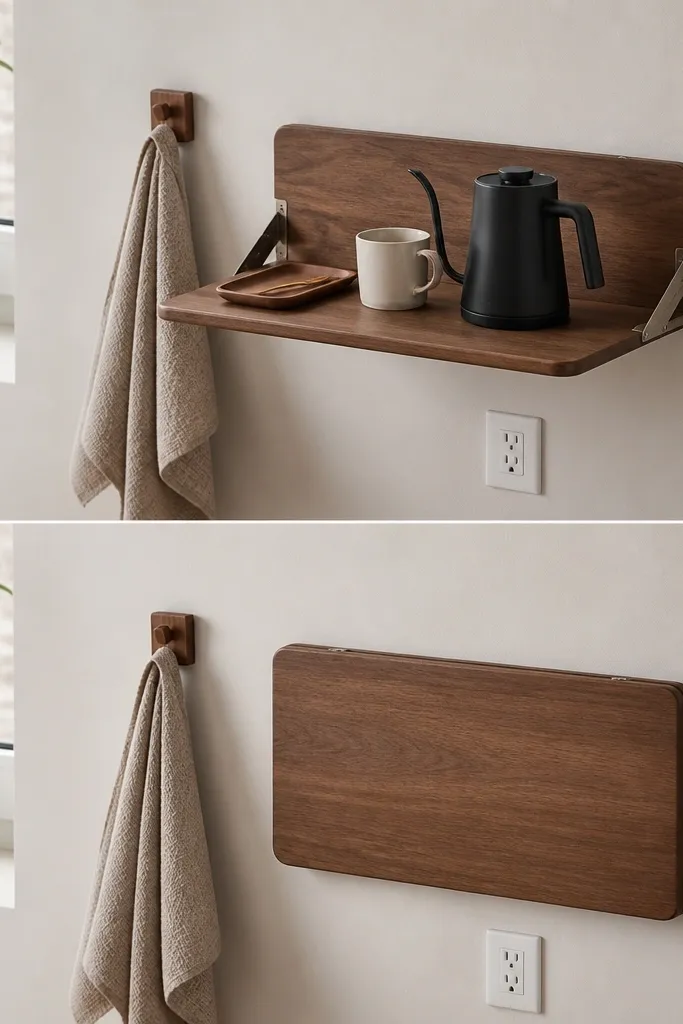
A fold-down shelf is the answer when you truly have no counter space. You get a coffee “bar” for the minutes you need it, then it disappears so your room stays calm. I’ve used this in a bedroom where the only open surface was a narrow desk and it was always covered with random stuff. The modern look comes from clean lines and a shelf finish that matches your wall trim or door color. If your skin tone is warm, the warm wood or light finish on the shelf makes the corner feel inviting rather than harsh. The principle is time-based display — the coffee area is active when you use it.
Good to knowUse a heat-safe silicone mat under the kettle so the shelf finish doesn’t get dull from steam.
Install a fold-down shelf with a supporting bracket rated for at least 20-25 pounds so it feels solid with a kettle on it. Choose a shelf width around 16-20 inches so it’s usable but not intrusive. When open, keep your daily items in a slim tray so nothing overhangs beyond the shelf edge. Put the kettle toward the back edge, mugs toward the front, and store filters in a small wall cabinet or drawer below. Add a towel hook next to it so you wipe spills immediately and keep the shelf surface clean.
AvoidAvoid placing a full-size coffee grinder on a fold-down shelf; vibration and weight make it feel unstable.
14. Corner gallery shelf with a coffee print and mini tray
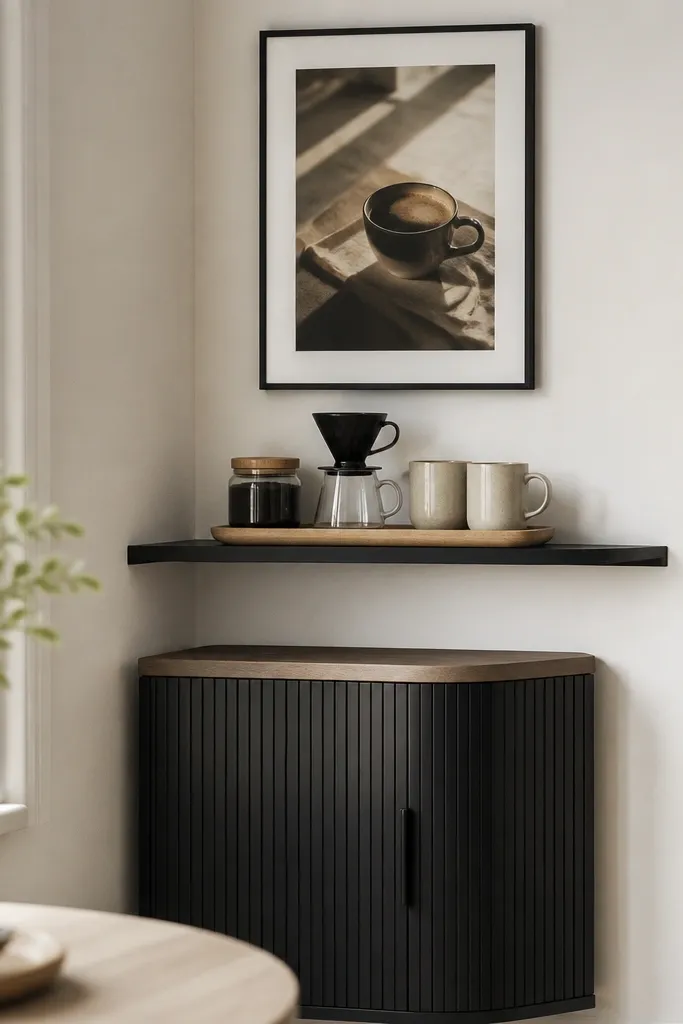
This is a decor-first coffee corner for people who want it to look like art, not appliances. The coffee print adds a focal point so your eye doesn’t get stuck on the countertop. I’ve used this in small bedrooms where the wall is empty and the corner needs personality, and it worked because the shelf is small and the print balances the composition. The black frame and mini tray keep it modern, while the ceramic pieces keep it warm. For lighter rooms, black accents make everything look sharper. The principle is composition: artwork above, coffee tools below, everything sized to the wall.
Good to knowChoose a print with muted colors so it doesn’t clash with your coffee canister lid.
Pick a corner wall shelf that’s about 12-14 inches wide with a depth under 6 inches so it doesn’t jut out. Hang the coffee print centered above the shelf with the bottom of the frame about 4-6 inches above the shelf surface. Place a mini tray on the shelf first, then put the canister and dripper on the tray so nothing spills out. Add exactly two mugs — one slightly angled so it looks intentional. Keep colors tight: black frame, cream or off-white ceramics, and one accent like walnut or brass.
AvoidAvoid oversized frames; in a small corner, big art makes the coffee shelf feel tiny and awkward.
15. Sofa-side coffee corner with a small pull-out drawer unit
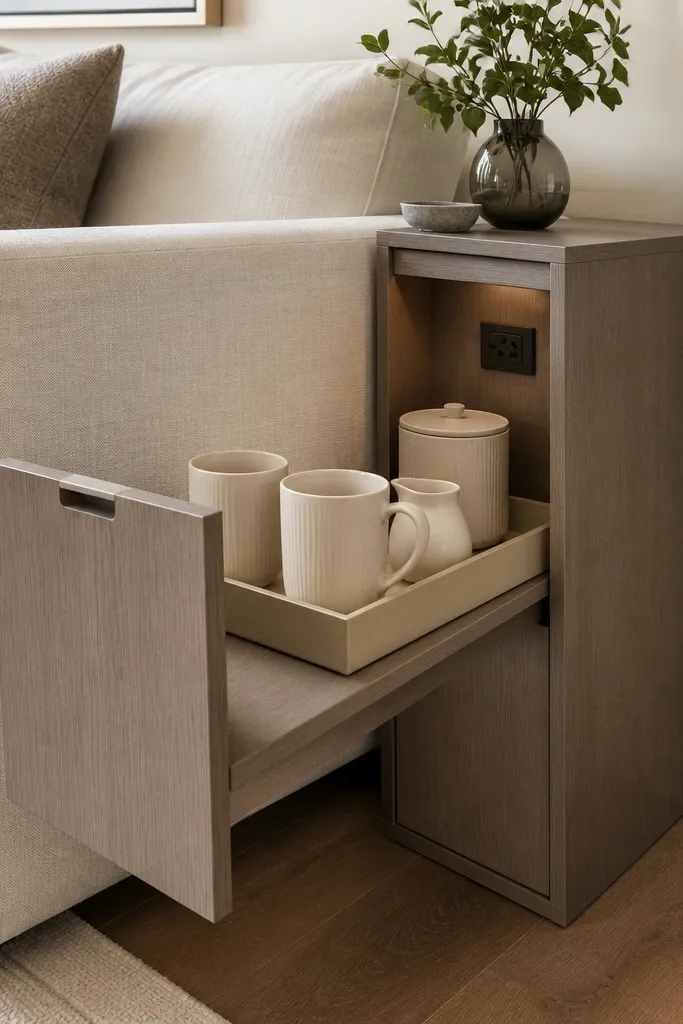
This setup is perfect when the coffee corner lives near a seating area instead of the kitchen. The pull-out drawer hides the coffee tools when you’re not using them, and the front tray makes it feel like a mini bar cabinet. I’ve installed similar units in rental living rooms by using a slim furniture piece that already had a drawer runner, and it instantly made the space look designed. Neutral drawer fronts keep it calm, and the drawer prevents that scattered “living room snack station” vibe. If your room has patterned pillows, the drawer unit keeps the coffee area grounded. The principle is concealed storage with a single working surface.
Good to knowLine the drawer with a thin, wipeable mat so spills don’t soak into the wood.
Choose a slim drawer unit width around 16-20 inches and keep the height so the tray slides out at about waist level. Pull the drawer out and place a tray inside that matches the drawer depth with 1 inch clearance. Put mugs on one side of the tray and the kettle or electric device on the other, leaving space for a spoon cup. Store filters and sweeteners in small stackable boxes inside the drawer so they don’t spill. Finally, add a small cord management clip if you’re plugging in a kettle so the cable doesn’t drag across the floor.
AvoidAvoid storing open coffee bags in the drawer; the smell spreads and the drawer looks messy.